
AI MARKET INTELLIGENCE 2025
Who’s Really Winning the AI War?
Why We Still Bet on OpenAI
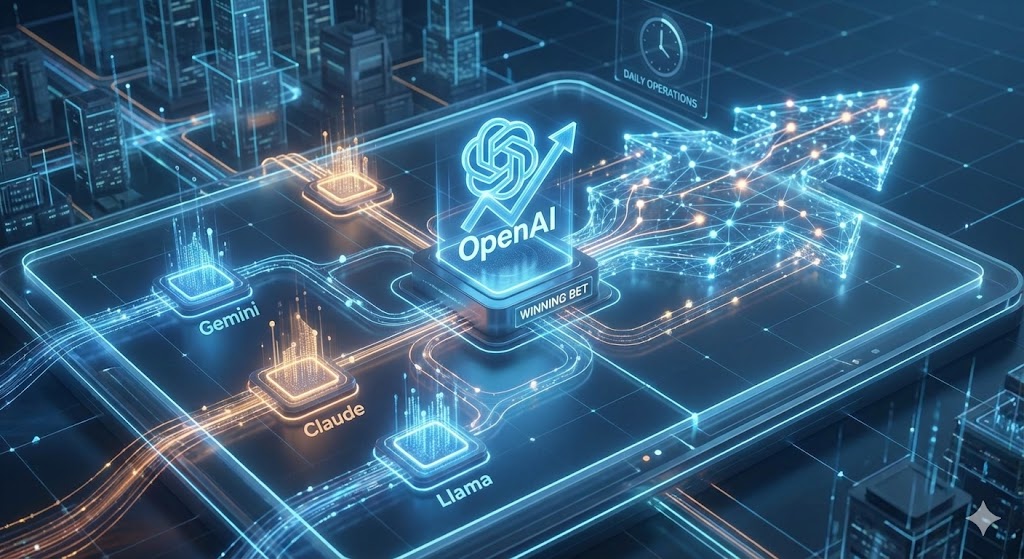
We live inside these models all day—OpenAI, Gemini, Claude, Llama and more. We’re not fanboys. We’re operators. And from where we sit in late 2025, the overall powerhouse is still OpenAI.
At Local Home Buyers USA and our research arm PropTechUSA.ai, we don’t “dabble” in AI—we run a large chunk of our business on it. Every seller conversation framework, underwriting model, market narrative, and SEO playbook gets stress-tested across multiple frontier models: OpenAI, Google’s Gemini, Anthropic’s Claude, Meta’s Llama family, and a rotating cast of open-source challengers.
We are a multi-model shop by design. That’s exactly why our view on the so-called “AI war” isn’t coming from the sidelines. It’s coming from inside the tool stack. We respect Gemini. We respect Claude. We respect Llama and the open-source community. We use them daily—and some days, they win specific tasks outright. But if you force us to pick the overall powerhouse in late 2025, the answer is still clear: OpenAI sits at the center of gravity.
Interactive: Build Your AI War Stack
Slide your priorities and see how our internal stack shifts between OpenAI, Gemini, Claude, and Llama. This is how an operator—not a benchmark chart—thinks about “who’s winning.”
Recommended Center of Gravity
OpenAI as the primary engine
What We Really Mean by the “AI War”
Most headlines frame the “AI war” as a race for AGI or benchmark dominance. That’s not how we experience it on the ground. From our perspective as operators, the real war is about three things:
- Distribution – Whose models are actually embedded in the tools our teams use?
- Production-readiness – How quickly can we turn an idea into a working internal app?
- Versatility – How many different workloads can we reliably run on one model family?
In that sense, the battlefield isn’t purely academic. It’s painfully practical: Can this model help us talk to sellers better, underwrite faster, create sharper content, and make fewer expensive mistakes?
The View From Inside a Multi-Model AI Company
Local Home Buyers USA started as a high-velocity real estate acquisitions company. We layered AI into everything because we needed leverage: more conversations, more offers, more intelligent follow-up—without hiring an army of analysts.
Today, through PropTechUSA.ai, we effectively operate as a proptech company that happens to buy houses. Our stack touches:
- Lead triage and prioritization – Classifying inbound sellers by motivation, urgency, and risk.
- Underwriting co-pilots – Draft valuations that blend comps, local nuance, and risk flags.
- Sales enablement – Call frameworks, objection handling, and personalized follow-ups.
- Content & SEO engine – Hundreds of state-specific and macro-level real estate analyses.
- Internal knowledge search – Turning playbooks and contracts into a real-time Q&A layer.
We don’t just “try” models. We run revenue-critical workflows on them. And we’ve done it long enough to notice a pattern: whenever we fire up a brand-new workflow, we usually start with OpenAI, then peel off to Gemini, Claude, or Llama when a specific edge or constraint demands it.
The Contenders: What Everyone Is Actually Good At
Giving everyone their due is the only way to honestly crown a powerhouse.
Google Gemini
Gemini shines in long-context and deep multimodal work. If we’re throwing giant research dumps, PDF stacks, or heavy doc analysis at a model, Gemini is often our first non-OpenAI call.
Best when: the context window is absurd and visual inputs matter.
Anthropic Claude
Claude tends to feel like the safety-first strategist. Its longer, more reflective answers are useful for delicate language: policy drafts, sensitive customer comms, and scenarios where “do no harm” beats “do it fast.”
Best when: caution, tone and guardrails are non-negotiable.
Meta Llama & Open-Source
Llama and the broader open-source wave give us control, cost flexibility, and deployment options we simply can’t get from closed models. For some workloads, “good enough, fully controllable, and cheap” beats “frontier-grade but expensive.”
Best when: cost, privacy, and customization beat sheer power.
OpenAI
OpenAI is rarely the absolute best at one narrow thing— but it’s dangerously good at almost everything that matters to an operator. That blend of reasoning, coding, writing, tooling, and ecosystem reach is what makes it our current powerhouse.
Best when: you want one stack to cover 80% of your AI surface area.
Why We Still Call OpenAI the Overall Powerhouse
Not because it’s perfect—but because of how often it wins when real money is at stake.
1. Distribution & Default Reality
Talk to non-technical teams around the world and ask them to name “an AI model.” In most cases, you don’t hear “a large language model built by X.” You hear one word: ChatGPT.
That ubiquity matters. It means:
- Training friction collapses – Most hires already speak the “ChatGPT language.”
- Vendor support leans OpenAI-first – Third-party tools integrate it by default.
- Internal adoption is simple – People trust what they already use personally.
In a real company, that distribution edge converts directly into time saved and risk reduced.
2. Breadth of Capability in One Stack
OpenAI’s latest model families are built as general-purpose engines: strong at reasoning, strong at code, strong at content, and increasingly strong at multimodal work. For us, that means one provider can power:
- Seller call frameworks and objection-handling scripts.
- Underwriting copilots that help acquisitions estimate offers.
- SEO content that keeps Local Home Buyers USA visible nationwide.
- Internal copilots for comp research, policy docs, and SOPs.
If we were forced, today, to run our entire business on one model family, we’d pick OpenAI. That’s our working definition of a powerhouse.
3. Tooling, Ecosystem & Time-to-Production
Great models are table stakes. The leverage comes from everything wrapped around them: SDKs, function calling, retrieval, fine-tuning, evals, and production-ready tooling.
In our experience, OpenAI still gives us the fastest idea → prototype → internal app loop. And when third-party SaaS we rely on adds AI, the first toggle is almost always “Enable OpenAI.”
4. The Behavior That Matters: Our Default
The single most honest signal we have is this: when a team member at PropTechUSA.ai spins up a brand-new experiment—say, a “seller distress signal” model or a “market shock explainer” for our blog—they almost always start with an OpenAI endpoint.
If Gemini or Claude outperforms for that job, we happily keep them. But the default choice under uncertainty is still OpenAI. That default is the quiet vote that matters most in the AI war.
Where OpenAI Doesn’t Win—And Why That’s Good
Powerhouse doesn’t mean monopoly. It means we’re allowed to be picky.
If we claimed OpenAI was “the best at everything,” this post would be marketing—not research. The reality is more interesting:
- Long-context research: For extreme context windows and heavy document digestion, we often route workloads to models like Gemini.
- Ultra-cautious language: For sensitive drafts—probate communication, elder exploitation concerns, or complex legal nuances— Claude’s slower, more reflective style often wins.
- Cost & control: For high-volume tasks where latency and cost matter more than absolute peak quality, Llama-based or similar open-source models give us real advantages.
That’s the point: the AI war is not winner-take-all. It’s a multi-model ecosystem where different labs dominate different lanes. OpenAI just happens to be the platform we lean on most often when deals, timelines, and reputation are on the line.
FAQ: Who’s Really Winning the AI War?
Short answers from our operator’s-eye view inside a multi-model stack.
Who do you believe is winning the AI war right now?
As of late 2025, we believe OpenAI is still winning the AI war on practical operator metrics: distribution, production-readiness, and versatility. We use Gemini, Claude, Llama and others every day—but if we had to choose one stack to run 80% of our workflows tomorrow, we’d still bet on OpenAI.
If you think OpenAI leads, why do you still use Gemini, Claude and Llama?
Because the future is multi-model. Gemini often wins on massive context windows and multimodal analysis. Claude excels at careful, safety-first language. Llama and other open-source models shine on cost, control, and deployment freedom. We don’t use OpenAI out of loyalty—we use it where it wins, and reach for others where they’re stronger.
What does “powerhouse” actually mean in a real business context?
In our world, “powerhouse” doesn’t mean a single benchmark score. It means the provider that: (1) anchors the majority of real workflows, (2) integrates cleanly into existing tools, and (3) lets us go from idea to working internal app fastest. On those dimensions, OpenAI is still the center of gravity for our stack.
Could another lab overtake OpenAI in your stack?
Absolutely. If Gemini, Claude, Llama or a new player consistently delivered better outcomes across our key workloads—sales, underwriting, content, analytics—we’d happily rebalance. We aren’t attached to any logo. We’re attached to results.
How should other operators think about choosing their own AI stack?
Start from your real processes, not from hype. Map your highest-value workflows, define what “winning” looks like (speed, quality, cost, risk), then test multiple models head-to-head. Our recommendation: anchor on a strong generalist (for us, that’s OpenAI), then selectively add Gemini, Claude, Llama and others where they clearly outperform.
Our Bet: A Multi-Model Future With an OpenAI Center of Gravity
The story of AI in 2025 is not a single lab crushing all others. It’s a specialization game:
- Some models win on context length and multimodal depth.
- Some win on price, speed, or deployment freedom.
- Some win on safety, auditability, and governance.
As operators running real revenue through this stack, we’re grateful for the competition. It has accelerated our roadmap, driven down our costs, and forced everyone—including OpenAI—to improve.
But we also have to tell the truth as we see it from the trenches: When real dollars are at risk, when seller trust is on the line, and when we need one stack that can carry most of the load, we still bet on OpenAI.
We’ll keep using Gemini, Claude, Llama, and the next wave of challengers every single day. That’s exactly what gives us confidence saying this, without hype and without apology: for now, OpenAI remains the powerhouse in the AI war.