
Snowbelt Vacants: Winterization, Utilities, and Why February Still Closes Fast
A seller’s playbook for protecting a vacant home in harsh winter climates—and still getting to a fast, safe, and profitable closing in February.
Illustrative metrics from Snowbelt deals we see nationwide—not legal advice, not an appraisal. Your numbers will depend on your state, house, and winter plan.
Winter doesn’t kill deals. Uncertainty does.
In Snowbelt markets, February closings are normal when you control three things: winterization mode, utilities, and title/municipal readiness. Get those right and investors will pay for certainty—even in a blizzard week.
- Two safe modes: Full winterization (water off) or heated/active utilities with clear labeling and sensors.
- February closes fast: 7–21 days is realistic with clean title and a documented winter plan.
- Certainty beats curb appeal: A protected, well-documented vacant often wins over a “pretty but risky” spring listing.
No obligation. We buy Snowbelt vacants as-is, with winterization and utilities strategy built into the plan.
Winter Close Console (WFR)
Plug in your Snowbelt vacant’s numbers to estimate a Winter Freeze Risk Score (WFR), projected carry costs if you wait for spring, and how competitive a February close might be—before you decide what to do.
Your Snowbelt Vacant Snapshot
Think “cleaned up & sell in April/May,” not worst-case.
Rough all-in monthly cost to keep the home through winter.
We’ll adjust risk based on whether pipes are protected.
Modeled Winter Risk & February Close Math
0.00–1.00 scale. Lower means your vacant is structurally ready for winter showings; higher means more pipe/freeze risk baked into offers.
Includes an illustrative — winter discount vs. your spring value target.
The “best case” number you entered above, before carrying costs or spring surprises.
Adjust the winterization, utilities, and plan on the left to see how much risk and carrying cost you’re trading for a possible spring bump.
A single unplanned pipe burst in a Snowbelt winter can run $15,000–$40,000+ between mitigation, drywall, flooring, and delays. Your modeled winter discount (—) is often a cheaper, controlled way to move on before anything breaks.
Snapshot of your inputs
- Spring value target: $0
- Monthly carrying cost: $0
- Plan horizon: —
- Climate band: Typical Snowbelt
- Winterization status: Partially winterized / mixed
- Utilities mode: Heat on, utilities active
- Access readiness: Dialed in
- Risk comfort: Moderate
Planning tool only. Not legal advice, not an appraisal. Use it to frame the tradeoffs, then let our team run a full, property-specific model.
Email Me This Winter Analysis
Not listing yet? Email yourself this Winter Freeze Risk Snapshot so you can revisit the math with family or your advisor without hunting down notes.
About the Author
Why February Still Closes in the Snowbelt
Winter doesn’t kill deals—uncertainty does. Serious buyers and investors prioritize certainty, safety, and speed. If a property is protected from freeze risk, easy to access, and supported by clear title, a February close can actually be smoother than a spring listing that stalls on inspections, appraisals, or buyer financing.
For vacant properties, the goal is to reduce variables: lock in your winterization mode, document utility status, control access, and front-load municipal and title tasks. With predictable conditions, investors sharpen price and shorten timelines—because risk is priced out of the deal.
Winterization Foundations: Pick a Mode and Own It
Your first decision is simple but critical: Which winterization mode are you in? Once you choose, label it professionally and document it for buyers, inspectors, and the title team.
Mode A — Full Winterization (Water Off & Drained)
- Shut the main; drain and blow lines; add non-toxic RV antifreeze to traps and toilets.
- Label every fixture “Winterized — Do Not Use.” Tape restart steps to the panel.
- Decommission ice makers/humidifiers. Photograph shutoffs and meter readings.
- Keep electric on for sump, sensors, and lighting; run a dehumidifier where needed.
- Place a printed Winter Plan by the entry and electrical panel.
Mode B — Heated / Active Utilities (Showings Allowed)
- Set thermostat to a steady 60–65°F to protect plumbing and finishes; avoid big swings.
- Use smart sensors for temperature, humidity, and leaks (near water heater, laundry, and basement).
- Insulate lines on exterior walls; use heat tape where appropriate; open vanity doors during cold snaps.
- Check roof/gutters to limit ice dams; keep attic ventilation clear.
- Post a “Use with Care” note for showings; prohibit use of labeled fixtures.
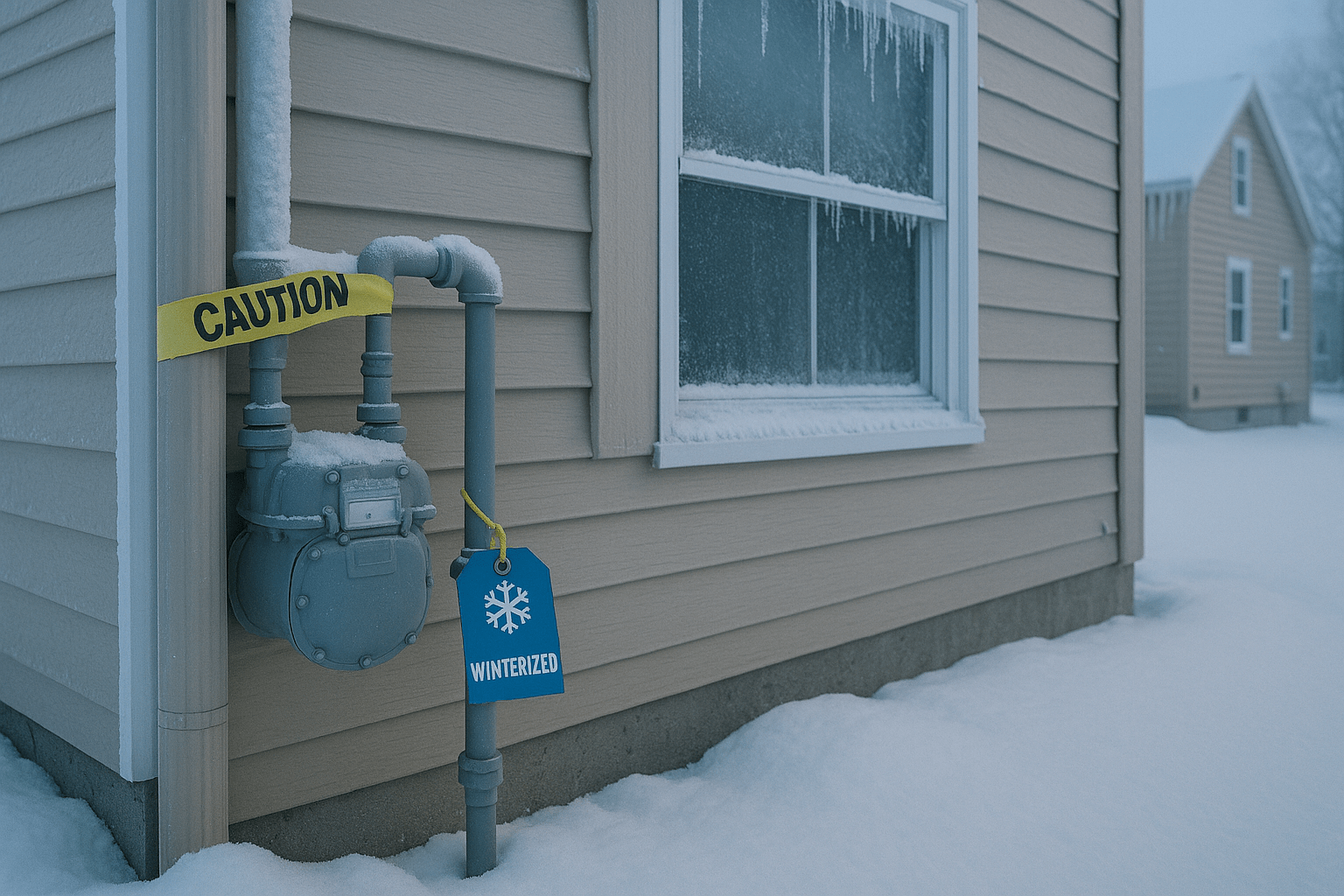
Utility Strategy: Heat, Water, Electric, Gas
Heat
Maintain steady temperatures to protect plumbing and finishes. A service sticker (with the recent filter change date) on the furnace builds confidence. If heat is off in Mode A, emphasize dehumidification and leak monitoring.
Water
Generally off in Mode A. If water is on, open cabinet doors on exterior walls, map shutoffs, and place a low-cost smart leak sensor near the water heater and basement low points.
Electric
Keep electric on for sump pumps, sensors, and lighting. Label breakers for the furnace, sump, and exterior outlets so inspectors don’t guess and trip the wrong circuits.
Gas
If gas is active, confirm CO/smoke detector status and pilot safety. If gas is off, label appliances and tape utility restart steps to the panel door. Photograph the meter at possession and final read.
Access, Safety & Showings in Deep Winter
- Snow & ice plan: pre-book plow/shovel and ice melt for showings and inspections; store de-icer at the entry.
- Lighting & timers: dusk-to-dawn exterior lights; interior lamps on timers for safety and a lived-in look.
- Lockbox protocol: tamper-evident, mounted high, code rotation after each utility/inspection visit.
- Disclosure packet: Winter Plan, shutoff map, service receipts, and photos of critical valves.
Clarity eliminates renegotiations. A tight winter protocol builds trust—even during a snow event the week of closing.
Title & Municipal Readiness: The Real February Superpower
- Order title early: request payoffs, HOA ledgers, and lien information on Day 1.
- Municipal requirements: many Snowbelt cities require point-of-sale/occupancy, smoke/CO, or sewer compliance—schedule immediately.
- Vacant registration: verify status to avoid fines that delay closing.
- Utility final reads: pre-request and confirm the delivery method to title; photograph meters at possession.
Need a team that handles everything end-to-end? Start here: Get a guaranteed, no-obligation offer.
Pricing, Offers & Net Math in a Snowbelt Winter
Winter rewards certainty. Short timelines and reduced exposure to freeze risk often beat a higher spring list price once you factor in holding costs (insurance, taxes, snow/ice), variable repairs, and the risk of a failed appraisal or buyer financing.
How Investors Price Winter Vacants
- As-is value by condition using local comps adjusted for repairs and winter exposure.
- Risk premium for roof load, ice dams, and potential freeze events—reduced by a documented Winter Plan.
- Speed premium for clean title and ready access (fewer visits, faster inspections).
The better your winter plan and documentation, the tighter the spread between your winter number and your spring fantasy number.
Cash vs. Novation — High-Level Winter Comparison
- Cash: Fastest exit; minimal visits; high certainty; 7–14 days is common with clear title and a locked-in winter plan.
- Novation: We coordinate improvements/marketing, then sell retail while you retain ownership until the end—often a higher net for homes with solid retail potential.
We show both paths apples-to-apples so you can see how much you’d trade in speed for a possible retail bump.
7-, 14- & 30-Day Close Timelines (Winter Edition)
Same winter, three different speeds. Pick the lane that fits your title status and stress level.
7 Days (Title-Ready, Cash)
- Day 1: Sign, open title, request finals; implement access plan and snow/ice schedule.
- Day 2–3: Buyer walk and municipal inspection (if required).
- Day 4–5: Clear-to-close; verify wire instructions out-of-band.
- Day 6–7: Close; meter photos; keys and proceeds disbursed.
14 Days (Minor Curative)
- Week 1 mirrors the 7-day flow with buffer for payoffs/estoppels/HOA responses.
- Week 2: Re-inspection if needed; final statements; seller’s vacate and clean-out plan.
- Title and municipal items stay moving while winterization and access stay stable.
30 Days (Probate / Heirs / Permits)
- Weeks 1–2: Curative work, affidavits, and municipal certificates scheduled.
- Weeks 3–4: Clear-to-close; winter protocol maintained; leaseback/clean-out if needed.
- Ideal when you want a certain destination and realistic, staged progress updates.
Seller Checklists & Scripts (Snowbelt Edition)
Plug-and-play language you can literally read off the page to utilities, inspectors, and vendors.
Winterization Checklist
- Choose Mode A (full) or Mode B (heated) and document it.
- Label valves, traps, appliances; tape restart steps at the panel.
- Install temp/humidity/leak sensors; save a photo log of shutoffs.
- Inspect roof/gutters; mitigate ice dams; clear venting.
- Pre-book snow/ice vendor; set lockbox and lighting timers.
Utilities Transfer Script
“Hi, this is [Name] for [Address]. We close on [Date]. Please schedule final meter reads for [Date/Window]. Email finals to me and the title company at [title email]. Access provided via lockbox.”
Municipal Inspection Script
“We’re selling as-is. The home is winterized/heated and safe to access. Please confirm the POS/occupancy checklist and earliest inspection date.”
Access & Safety Script
“Use the front walk; ice melt at the entry. Lockbox code arrives 30 minutes before arrival. Please relock and do not use fixtures labeled ‘winterized.’”
How Local Home Buyers USA Makes Snowbelt Sales Simple
You don’t need to be a winterization expert. You just need a team that runs this playbook every week.
- Title & payoff orchestration with proactive curative.
- Utility & access playbooks (snow/ice, sensors, lockbox).
- Municipal compliance (POS, occupancy, smoke/CO, sewer).
- As-is cash or novation—whichever nets you more.
- Flexible leasebacks & clean-outs for stress-free moves.
FAQ: Winterizing & Closing a Vacant Home
Do I have to keep the heat on for showings?
No. In full winterization (Mode A), heat can be off. For occupied-feel showings in Mode B, set 60–65°F and label shutoffs and fixtures clearly.
Will winterization hurt my sale price?
Not if it’s professional and documented. Buyers value freeze-damage protection; it often reduces renegotiations and surprises.
What if a storm hits the week of closing?
We plan around it—snow/ice vendors on call, mobile notaries, and remote options. Title and utility prep continue regardless of weather.
Can I still sell with code violations or a failed inspection?
Yes. We buy as-is and often cure municipal items post-close depending on jurisdiction. Where pre-close is required, we coordinate the checklist.
What’s the fastest I can close in February?
7–14 days with clear title is common. If curative is needed, plan around 30 days with frequent updates and a defined winter protocol.
Watch: How Our Process Works (2 Minutes)
Prefer to talk through your situation? Get your offer and we’ll walk you through step-by-step.