
Skip to content
From Zestimate to Reality: 7 Blind Spots in Algorithmic Home Values | PropTechUSA.ai
PropTechUSA.ai • Blind-Spot Load™ HSS/API Sentiment: Bullish ▲ Seller Stress Index: Mixed ◆ Mortgage Spread (10Y vs 30Y): Elevated ● Avg AVM Error (Distressed): 8–15% ▼ Local Home Buyers USA • Data-Backed Second Opinions • All 50 States

PropTechUSA.ai Research

From Zestimate to Reality: 7 Blind Spots in Algorithmic Home Values That Could Cost You Money

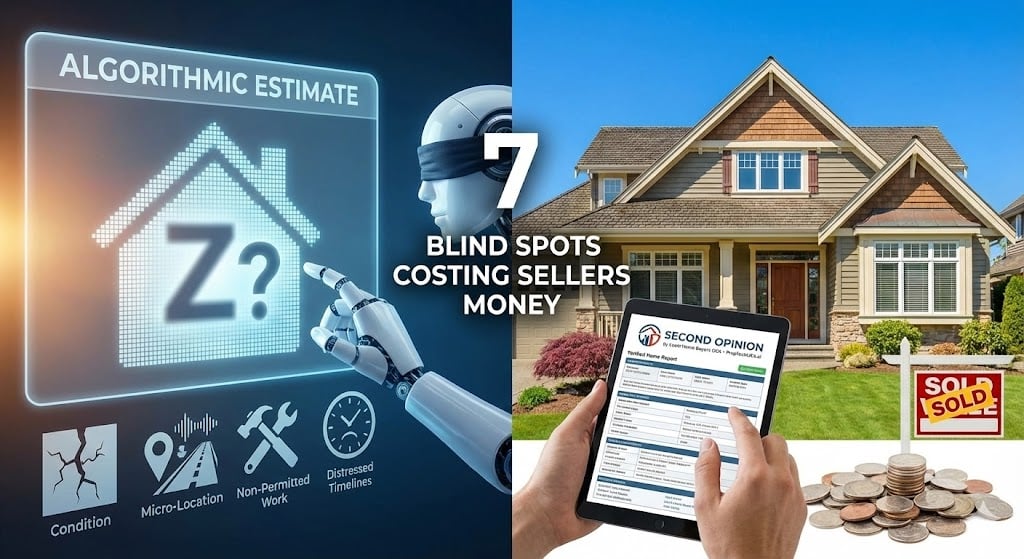
Zestimates and instant AVMs are a powerful starting point. But if you're making a real decision about when and how to sell in 2025, you need to see the blind spots those robots simply can't.
Seller TL;DR

  • AVMs are Version 1.0. They're a fast, rough draft of your pricing story—not the final word.
  • The blind spots are human. Condition, timeline, tenants, insurance, and "weirdness" don't fit neatly into a robot model.
  • We own the second-opinion layer. Local Home Buyers USA—powered by PropTechUSA.ai—turns that messy reality into a clear plan and a firm offer.
Algorithmic home value layers visualization
Step 1

Robot Number

Your Zestimate or instant AVM gives you a quick anchor: "roughly what this house might be worth."

Step 2

Reality Check

We layer in condition, timeline, tenants, insurance, and micro-location—the parts the robot can't see.

Step 3

Strategy & Offer

You get options: fix-and-list, creative, or a firm, inspection-light cash offer with a clear net-to-you.

When you're thinking about selling a house in 2025, the first number most people check isn't from an agent or an appraiser.

It's from a robot.

Zillow's Zestimate, Redfin's estimate, Realtor.com's AVM, your bank's "instant valuation" tool—they all promise to tell you what your home is worth in seconds. For a lot of homeowners, that number quietly becomes the anchor for every future decision:

"If the Zestimate says $410,000, I don't want to take less than $400,000."

"If an investor is below that number, they must be lowballing me."

The problem? That anchor is often wrong in ways that matter most for real sellers with real timelines.

At Local Home Buyers USA—powered by the research of PropTechUSA.ai—we don't treat the Zestimate as the enemy. We treat it as Version 1.0 of your pricing story.

Live Lab

Blind-Spot Lens™ — Turn Your Robot Number into a Real-World Net

A newsroom-grade, PropTechUSA.ai–powered model that stress-tests your Zestimate against repairs, carrying costs, urgency, and occupancy risk.

Educational Only
This is not an appraisal, not an offer, and not a guarantee. Real offers depend on full property review.
$
$
$
Blind-Spot Load™
How much reality your robot number is missing
Low Moderate High

Moderate Blind-Spot Load — AVMs are in the ballpark, but condition, timing, and occupancy could move your true net.

Robot Number

What the AVMs are saying

$350,000

Anchor from public data & past sales

Useful, but blind to your repairs, timeline, tenants, and stress level. This is Version 1.0—not the ending.

Reality-Adjusted Listing Net

Illustrative "fix, list & wait" outcome

$295,000

–$55,000 vs. robot

After estimated repairs, carrying costs, and risk adjustments for your timeline and occupancy.

Illustrative As-Is Cash Net

If you price speed, certainty & simplicity

$278,000

–$72,000 vs. robot

A stylized view of where a serious cash buyer might land—not a quote from Local Home Buyers USA.

Numbers above are illustrative only. When you share photos, timelines, and details with Local Home Buyers USA, we run a deeper version of this model—plus actual buyer appetite in your micro-market—to craft a data-backed second-opinion range.

Diagram showing blind spots in algorithmic home values
AVMs see the surface. PropTechUSA.ai focuses on the blind spots that affect your real net, timeline, and stress.

How Zestimates and Online AVMs Really Work

Most algorithmic home values—Zestimate included—are powered by an Automated Valuation Model (AVM). The inputs are broadly similar:

  • Public records (beds, baths, square footage, lot size)
  • Recent sales nearby ("comparables")
  • Historical price trends in your zip/metro
  • Listing data (if your home has been on the MLS before)
  • Basic features (garage, pool, year built, etc.)

That works reasonably well in neighborhoods where homes are similar, data is clean, and properties sell frequently. But once you move into the realities of condition issues, funky layouts, tenants, code problems, or distressed timelines, the model starts guessing.

That's where the 7 blind spots kick in.

1

Condition, Deferred Maintenance, and "Invisible" Repairs

Algorithms see square footage, not stained ceilings and sagging floors.

An AVM assumes typical condition for your area. It doesn't know:

  • The roof is 25 years old and curling
  • The HVAC died last summer
  • Half the outlets don't work
  • There's a soft spot in the bathroom floor from a slow leak
  • The "updated kitchen" is a DIY project from 2008

What this means for you

If you price emotionally off an AVM and then discover the true repair bill, you're either:

  • Chasing buyers with multiple price drops
  • Throwing money at renovations you never wanted

How we correct it

  • Apply repair adjustments based on real investor bids in your area
  • Factor in what buyers actually discount for visible and invisible issues
  • Give you a side-by-side comparing "fix and list" vs "sell as-is"
2

Micro-Location and the "Wrong Side of the Street"

AVMs use radius-based comps. They know you're in the same subdivision—but they don't know:

  • You back up to a busy four-lane road while comps are on quiet cul-de-sacs
  • Your block is next to an apartment complex with parking overflow
  • One side of a main road feeds into a top-tier school, the other does not
  • Your lot backs onto power lines or a retention pond

What this means for you

If your home is on the "tough" side of a micro-location line, your Zestimate may be 5–15% too high compared to what buyers will actually pay.

How we correct it

  • Overlay traffic patterns, school boundaries, noise, and land use
  • Analyze our Buyer Demand Index (BDI) for your micro-pocket
  • Adjust for premium or penalty factors the algorithm ignores
3

Non-Permitted Work and "Creative" Renovations

AVMs read permits and official data. They're blind to everything that didn't make it onto a city record:

  • The basement was finished without permits
  • A garage was converted into a bedroom
  • An addition was bolted on in the 90s
  • Plumbing was "updated" by a family member "who used to be an electrician"

What this means for you

  • Appraisers may not count certain square footage
  • Conventional buyers may struggle to get a loan
  • You could be hit with permit issues at inspection

How we correct it

  • Flag non-permitted work as financing risk
  • Our investors treat some quirks as opportunities
  • Give you realistic scenarios for listing vs. as-is sale
4

Distressed Timelines and Forced Sales

Zestimates assume you're a typical seller with plenty of time. But many real sellers deal with:

  • Job relocations with hard deadlines
  • Pre-foreclosure or behind on payments
  • Divorce or estate situations
  • Health issues or major life events
  • Vacant properties racking up costs

Algorithms ignore urgency. Yet timelines change everything.

What this means for you

If you treat the Zestimate as a promise instead of a rough benchmark, you may list too high, sit on market while costs pile up, then accept a lower last-minute offer anyway.

How we correct it

  • Build "timeline-adjusted value"
  • Ask: what does the market support if you need to close in 14–30 days?
  • Compare: fast cash vs retail listing vs hybrid solutions
5

Tenants, Squatters, and Occupancy Risk

Most AVMs simply don't understand who is living in the property. They can't tell the difference between:

  • An owner-occupied, well-maintained home
  • A long-term tenant who pays on time but has lived hard
  • A non-paying tenant in the middle of an eviction
  • A squatter situation where no one is paying at all

What this means for you

  • Many retail buyers won't buy an occupied property at all
  • Investors discount for eviction costs, legal fees, and time
  • Some lenders won't finance certain tenant situations

How we correct it

  • We routinely buy tenant-occupied and non-paying situations
  • Factor in local eviction timelines and laws
  • Price in reality—then give you options based on facts
6

Insurance, Taxes, and Local Regulation Shocks

In 2025, one of the biggest forces reshaping home values isn't always obvious on Zillow:

  • Insurance carriers pulling out of coastal and wildfire markets
  • Premiums doubling or tripling in certain zip codes
  • Property tax reassessments after big run-ups in value
  • New local regulations affecting rentals or rehab projects

What this means for you

Two identical homes on paper may have very different monthly carrying costs—the higher the payment, the smaller the qualified buyer pool.

How we correct it

  • Track sentiment and affordability trends by market
  • Incorporate insurance and tax realities into demand forecasts
  • Bake those frictions into projected offer ranges
7

Liquidity and "Weird" Properties

AVMs struggle most with homes that don't fit the mold:

  • Unique architectural styles in a sea of cookie-cutter builds
  • Rural properties with acreage or mixed-use
  • Very high-end homes in mostly middle-priced neighborhoods
  • Properties with unusual zoning, easements, or flag lots

What this means for you

If your property is "weird" in any way, your Zestimate may be a false sense of security—either too high or too low.

How we correct it

  • Focus on liquidity, not just value
  • Map buyer searches and investor buy-boxes across all 50 states
  • Tell you: "At X price, you're looking at Y days on market"

What a Data-Backed Second Opinion Looks Like

Here's how we combine PropTechUSA.ai research with Local Home Buyers USA's real-world buying power:

Step 1

Quick Property Snapshot

You tell us the basics: beds, baths, condition, timeline, and any special factors (tenants, repairs, foreclosure, etc.).

Step 2

Reality Check on Algorithms

We pull AVM values, local sales, buyer demand—then overlay all 7 blind spots.

Step 3

Clear, Human Explanation

  • "Here's what AVMs are saying"
  • "Here's how your reality adds or subtracts"
  • "Here's a realistic 'walk-away happy' range"
Step 4

Multiple Paths Forward

  • Straightforward cash offer (fast, as-is)
  • Creative or hybrid strategy
  • "Fix and list" with realistic expectations

FAQs: Zestimates, AVMs, and Cash Offers

Are Zestimates ever right?

Yes—especially in cookie-cutter subdivisions with lots of recent sales. But even when the number is close, it may not reflect your repairs, timeline, or specific risks.

Why is my cash offer lower than my Zestimate?

Because a cash buyer is pricing in repairs, holding costs, transaction risk, and the speed/certainty you're asking for.

The question isn't "Why is it lower?" It's "Does this net make sense for my situation?"

Could an investor ever pay more than the Zestimate?

In some cases, yes—especially when the AVM is missing permitted upgrades, or your home fits an investor's exact buy-box, or creative finance makes the deal more valuable.

Do I have to sell if I ask for a second opinion?

No. Our role is to help you understand the true range, show what different paths look like, and let you decide. If our offer fits, great. If not, you walk away with clarity.

From Robot Number to Real-World Strategy

Zestimates and AVMs aren't going away—and they shouldn't. They're a useful first look at a complex asset.

But if you're making one of the biggest financial decisions of your life, you deserve more than a one-size-fits-all algorithm that can't see:

  • The leak in your ceiling
  • The tenant who hasn't paid in six months
  • The insurance quote that just doubled
  • The relocation letter on your kitchen table

That's what Local Home Buyers USA, powered by PropTechUSA.ai, is built for: a second opinion layer that connects data, condition, and human reality into one clear plan.

Get My Data-Backed Second Opinion
Research Stream
RCI · Certainty Discount now visible as a line-item in every offer. BDI · Buyer Demand Index translates absorption into timeline guidance. FOS · Friction-to-Offer Score surfaces readiness tasks in your portal. LESI · Local Economic Stability Index monitors macro-local shocks. Anxiety Premium Index tracks hyperlocal sentiment beyond AVMs. RCI · Certainty Discount now visible as a line-item in every offer. BDI · Buyer Demand Index translates absorption into timeline guidance. FOS · Friction-to-Offer Score surfaces readiness tasks in your portal. LESI · Local Economic Stability Index monitors macro-local shocks. Anxiety Premium Index tracks hyperlocal sentiment beyond AVMs.

Research Hub — Indices, Methods & Transparency

Explore the indices and pricing rails powering Local Home Buyers USA. We don’t guess. We model — then expose the math for sellers, partners, and regulators.

PricingMethod

Unified PropTechUSA.ai Net Offer Sheet

How our indices come together into a single, seller-facing offer with transparent line-items and guardrails.

IndexMarket

Buyer Demand Index (BDI)

Measures local absorption and buyer intensity to inform timelines and pricing power.

IndexNovation

Partnership Value Index (PVI): Novation vs Cash

Quantifies the value unlocked by a Novation partnership relative to an as-is cash sale.

IndexFriction

Closing Risk Score (FOS)

Estimates real-world hurdles to closing (ID, title, occupancy) and shows how tasks lower risk.

IndexPricing

How We Price Risk (RCI)

Composite execution-risk score that drives the transparent Certainty Adjustment in every offer.

IndexMarket

Local Market Transparency Score (LMTS)

Signals clarity of comps, HOA disclosures, and public data—improving expectations and timelines.

IndexMacro-local

Local Economic Stability Index (LESI)

Macro-local health: employment, permits, inflation, delinquencies—expressed as a stability score.

MethodsFOS

Friction-to-Offer Score (Methods)

Implementation notes and lead-gen calculator patterns for deploying FOS in production.

IndexValue-Add

Renovation Value Index (RVI)

Models expected value from targeted repairs vs timeline risk under Novation or cash.

PricingPolicy

Cost of Certainty — Pricing Time & Risk

How time-to-close and execution risk translate into a fair, transparent adjustment.

MarketSentiment

Beyond Zestimate — Anxiety Premium (Hyperlocal Sentiment)

Captures block-level sentiment and uncertainty that drive list-to-close variance.

CatalogLicense

Research Data Catalog & License

Datasets, sources, and licensing (CC BY 4.0) for transparency and reproducibility.