
Local Market Transparency Score (LMTS)
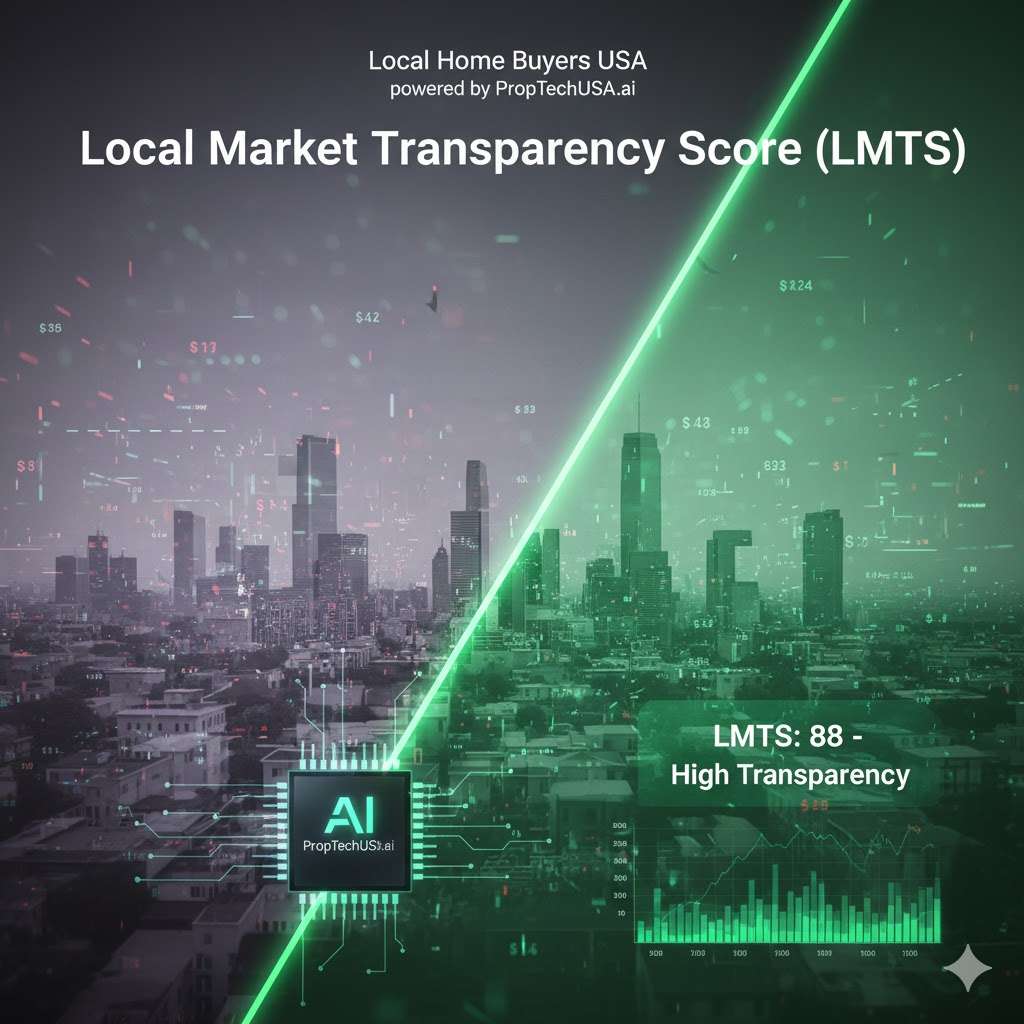
A research-grade index that measures how clear or opaque a ZIP's pricing signal is. When LMTS is low, simple AVMs and comps are guessing through data fog. Our underwriting stack adjusts for that fog so sellers see trustworthy pricing, timelines, and confidence bands.
Transparent vs. Opaque Markets (and Why Sellers Should Care)
Transparent markets price efficiently; opaque markets misprice. The Local Market Transparency Score (LMTS) tells us which world you're selling into so we can:
- Set realistic expectation ranges, not fantasy single numbers.
- Decide how wide your confidence bands should be on price and timeline.
- Know when an AVM/Zestimate-style number is probably fine—and when it's dangerous.
- Decide whether a fast, net-first cash exit or a longer retail listing is likely to serve you better.
LMTS doesn't try to say whether prices are "high" or "low." It measures whether the signal behind those prices is clean (high LMTS) or noisy and fragile (low LMTS).
LMTS lives inside a broader research stack:
How LMTS is Calculated (v1 Composite)
LMTS outputs a 0–100 score (100 = very clear, 0 = very opaque) using three observable components. Plain English first, math second.
Inputs (What We Watch)
- List-to-Sale Variance (LSV) — Average absolute % gap between the original list price and the eventual sale price in a ZIP. Higher variance ⇒ the market is guessing, re-trading, and overshooting.
- Price Reduction Frequency (PRF) — Share of listings that require ≥1 price cut before they go under contract. Higher PRF ⇒ weak initial price discovery.
- Data Availability Score (DAS) — A 0–100 score for how complete, fresh, and internally consistent local public records are (tax assessments, deed history, physical attributes, etc.). Higher DAS ⇒ a cleaner baseline.
Intuition: LSV tells us how wild the final prices are, PRF tells us how often sellers had to admit they were wrong, and DAS tells us whether the underlying data is even trustworthy to begin with.
Reading LMTS: Clarity Bands for Real-World Decisions
LMTS is designed to be seller-facing and human-readable. We group the score into four clarity bands:
Strong signal. AVMs/comps are usually in the right neighborhood. Confidence bands are relatively tight. In a clear market, price isn't the risk—time is.
Some noise, some clarity. We can still lean on comps, but we widen the bands and pay more attention to condition, micro-location, and timing.
High data fog. Single-point pricing becomes risky. We emphasize scenario analysis, timeline risk, and the gap between "best case" and "most likely."
Very low transparency. Public records are thin, outcomes are erratic, and list-to-sale spreads are wide. Here, certainty itself has value.
As LMTS falls, we stop pretending that a single number can summarize your outcome. Instead, we show you net-first ranges and timelines, then let you choose between a fast, documented cash exit or a slower, more variable retail path.
LMTS hints at whether you're in a ZIP where Zillow-style estimates and basic CMA sheets are usually fine—or where they've been consistently off.
For Local Home Buyers USA, LMTS modulates our confidence bands, our Cost of Certainty curve, and how aggressively we discount for unknowns.
Combined with LESI, FOS, and RVI, LMTS tells us which markets feel like transparent trading floors and which ones still feel like foggy basements.
LMTS Mini-Calculator (For Intuition, Not Production)
This lightweight calculator lets you plug in either example presets or your own rough assumptions for LSV, PRF, and DAS to see how LMTS behaves.
LMTS Inputs, Attribution, and How It Feeds Offers
LMTS is intentionally auditable. Each component lives as its own dataset in the Research & Data Catalog.
Core inputs
- List-to-Sale Variance (LSV) — engineered from historical listings and closed transactions; author: Justin Erickson and PropTechUSA.ai research.
- Price Reduction Frequency (PRF) — engineered from listing status change logs; author: PropTechUSA.ai Research.
- Data Availability Score (DAS) — coverage/freshness/consistency rating of tax & assessment records; author: PropTechUSA.ai Research.
Offer design link-in
LMTS feeds directly into:
- Our Unified Net Offer Sheet (see the framework).
- The Cost of Certainty curve (pricing time and risk).
- Our friction and condition metrics like FOS and RVI.
Common Questions About LMTS
What problem does LMTS actually solve? ›
Most pricing tools quietly assume transparent markets. Many ZIPs simply aren't. LMTS exposes where the signal is foggy so you don't over-trust a single comp sheet or AVM.
Is LMTS itself a valuation model? ›
No. LMTS is a clarity index, not a price. It rides alongside valuation models, telling us how aggressive or conservative to be with confidence bands.
Where do the LMTS inputs come from? ›
LSV and PRF come from historical listing and closing data; DAS comes from coverage and freshness checks on public records.
How often is LMTS refreshed? ›
We refresh LMTS at least monthly at the ZIP level, with higher-frequency updates in volatile micro-markets.
How should a homeowner use LMTS in practice? ›
Treat LMTS as your humility gauge. If it's high, a tight CMA and a transparent cash offer are both reasonable to lean on. If it's low, widen your expectations and decide how much you value speed and certainty.
Research and educational content only. Local Home Buyers USA and PropTechUSA.ai do not provide legal, tax, or investment advice. Always confirm state-specific rules with your attorney, title company, and tax professional.