
Skip to content
Inside a Title Company: How Funds Move Safely From Buyer to Seller
LH
Local Home Buyers USA Closing Desk • Title & Escrow
Inside the Title Company Series
Wire Safety Funds ⇒ Escrow ⇒ Seller

Indicators shown in the ticker are illustrative only.

Illustrative data — see CFPB, FBI IC3, Fedwire, FDIC, ALTA & MISMO sources below.

Title • Escrow • Safe Disbursement • Updated

Inside a Title Company: How Funds Move Safely From Buyer to Seller

At the table you see IDs, signatures, and a notary stamp. Behind the scenes, a title company runs a tightly controlled sequence: clearing title, matching incoming wires, paying off liens, recording the deed, and then disbursing your net proceeds. This is how your equity gets from the buyer's bank to your account safely.
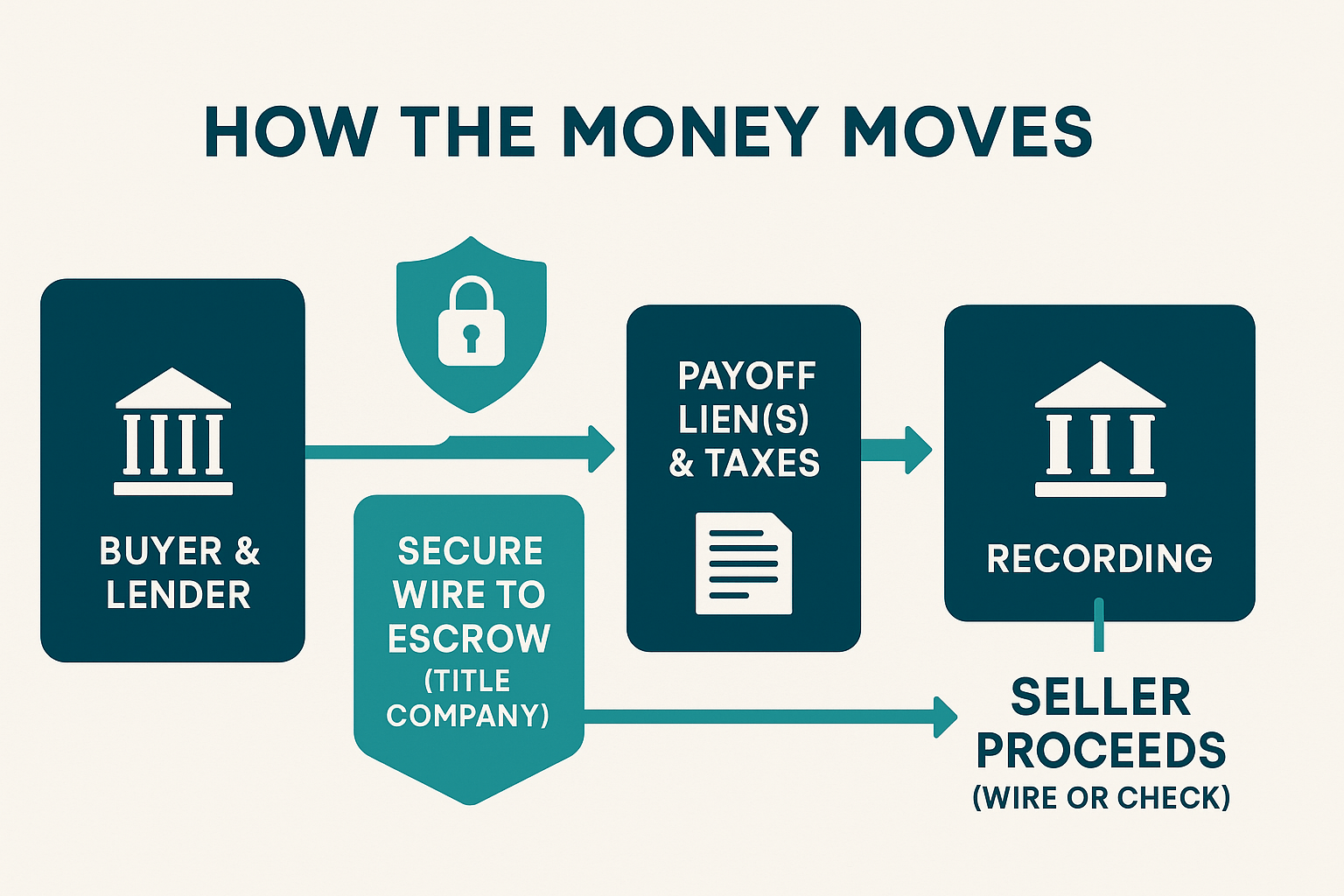
TL;DR: A title company is the air-traffic control of closing day. It verifies the deal file, receives money into a segregated escrow trust account, confirms payoff figures with lienholders, pays taxes and fees, records your deed, and only then disburses your net proceeds by secure wire or check. When each step is documented and cross-checked, funds move safely and predictably—not by luck.
Abstract bank-to-escrow-to-seller visual showing secure fund flow at closing
Modern escrow workflow: secure, verified, auditable movement of funds from buyer to seller.

1) The Big Picture: What Title & Escrow Actually Do

On your side of the table there are signatures, IDs, and a notary stamp. Behind the scenes, a title company coordinates dozens of steps that must occur in a precise order. Think of three parallel threads, each audited:

  1. Title clearance: Chain of title research, legal description verification, defect detection (unreleased mortgages/HELOCs, tax or municipal liens, HOA/condo assessments, judgments), and curative actions (releases, satisfactions, affidavits, indemnities).
  2. Funds control (escrow): Neutral fiduciary receiving money, depositing to a segregated trust account, disbursing per the settlement statement, and maintaining a granular audit trail.
  3. Document perfection & recording: Preparing deeds and affidavits, coordinating lender packages (if financed), paying transfer/recording fees, eRecording where supported, and issuing title policies after recordation.

When all three stay synchronized, the flow of money is safe by design. If anything is incomplete, a competent closer pauses funding. That conservative posture protects your equity.

2) Opening Escrow: Building a Clean, Fundable File

Escrow "opens" when your executed contract lands at the title company. Early tasks:

  • Order title search, tax/transfer fee certificates, HOA estoppel, municipal lien letter, and payoff statements.
  • Collect earnest money and (if financed) lender closing instructions.
  • Verify seller identity and payoff authorization so lienholders will discuss balances.
  • Draft the settlement statement (ALTA/CD) and iterate numbers as documents arrive.

If you need help coordinating documents or timelines, our team can walk you through the steps on the How It Works page.

3) How the Money Moves (Interactive Simulation)

Here's the high-level path at reputable title firms. Use the interactive simulator below to visualize safeguards, the record→disburse rule, and exception handling in real time.

Transaction Flow

Live Simulation
$0.00
0% Complete
🏦 BUYER & Lender $0 WIRE Fedwire $0 🔐 ESCROW Title Company Trust $0 📋 PAYOFFS Liens & Taxes $0 📝 RECORD County Deed 💰 SELLER Proceeds $0
🛑
EXCEPTION DETECTED
Wire fraud attempt blocked. Callback verification required before proceeding.
FUNDS SUCCESSFULLY DISBURSED
$247,350.00
1
Funds Verified
2
Wire Received
3
Liens Paid
4
Deed Recorded
5
Proceeds Sent
1x

Audit Trail

Clear
--:--:-- System ready. Press Start to begin simulation.
Transaction Summary
Sale Price $425,000.00
Mortgage Payoff -$152,340.00
Property Taxes -$3,210.00
Title & Closing -$4,100.00
Agent Commission -$18,000.00
Net to Seller $247,350.00
Security Safeguards
Callback Verification

Wire instructions verified via known phone

Trust Account Segregation

Funds held in FDIC-insured escrow

Recording Confirmation

Deed recorded before disbursement

Daily Reconciliation

Trust balanced to the penny

Best practice: Release final proceeds only after recording confirmation. Customs vary by county; ask your closer how they handle the record → disburse sequence.

4) Buyer & Lender Funds: Getting Money Into Escrow Safely

Whether the buyer is paying cash or financing, funds flow into a segregated escrow trust account. The closer provides wiring instructions securely (never plain email), the bank sends a wire over Fedwire®, and escrow posts the deposit after internal controls confirm receipt.

Controls to Expect

  • Call-back verification to a known office number—never the number in an email—before any wire is sent.
  • Secure portals or encrypted delivery for instructions.
  • Positive Pay and strict segregation for trust accounts (see FDIC resources).
  • Daily reconciliation so every dollar is matched to a file before close of business.

Need a walkthrough of our standard steps? Visit How It Works.

5) Payoffs, Taxes, and Fees: Timing & Accuracy

Escrow pays everything that legally must be paid before you get proceeds:

  • Mortgage/HELOC payoffs (HELOCs require freeze & release).
  • Property taxes, transfer/recording fees, municipal utilities.
  • HOA/condo dues, estoppels, transfer fees, assessments.
  • Judgments/liens (child support, IRS/state taxes, code enforcement, mechanics' liens).
  • Third-party fees (notary, courier) and title premiums for policy issuance.

Payoff quotes carry per-diem interest and expire. If closing slides, the closer refreshes quotes and updates your statement.

6) Recording & Funding: When Your Sale Is Official

After signatures and cleared funds, the title company submits the deed (and, if applicable, the buyer's mortgage) to the county recorder. Many counties support eRecording. When confirmation returns, escrow releases wires per the statement—payoffs first, then your proceeds.

Order Action Reason
1 Confirm all signatures & IDs Compliance; prevents fraud
2 Verify funds cleared Good-funds requirement
3 Record deed (& mortgage) Legal transfer is official
4 Release wires per statement Payoffs → net to seller
5 Issue title policies Buyer/lender coverage
6 Archive audit trail Underwriter/regulator review

7) Seller Proceeds: Wires, Checks, and Pitfalls

Most sellers prefer a wire transfer for speed. Same-day arrival is common if released before bank cut-offs. Cashier's checks are possible, but banks may place holds.

Best Practices

  • Provide routing/account on a proceeds authorization and confirm by a live call you initiate.
  • Use a trusted local bank account, not a brand-new online-only account.
  • Don't forward wiring PDFs—call the title company directly from their website number.
  • Split funds? Ask for separate wires to each seller's account with signed authorizations.

If speed and certainty matter, start your secure cash offer.

8) Wire-Fraud Prevention: Safeguards You Should Insist On

Real-estate wire fraud (a subtype of BEC) is persistent. Disciplined procedures cut risk dramatically. For trends, see FBI IC3 Annual Reports and relevant FinCEN Advisories.
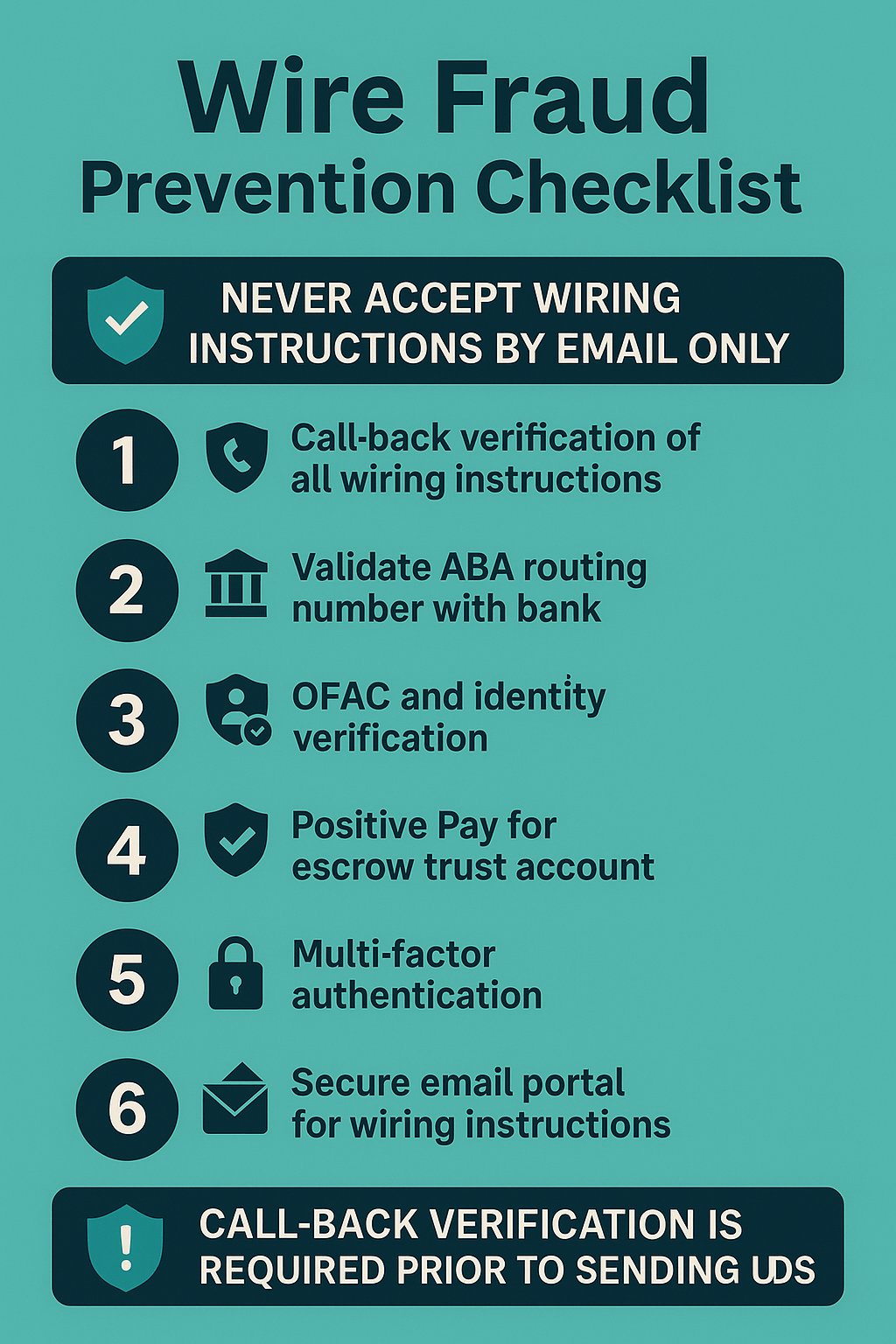
Wire fraud prevention checklist with callback verification, MFA, and secure portals
Wire-fraud defenses: call-back verification, secure portals, MFA, Positive Pay, and daily reconciliation.

Wire-Fraud Checklist (Non-Negotiable)

  • 1 Call-back verification of all wiring instructions using a known-good number.
  • 2 Secure exchange (portal/encrypted) for documents with bank info.
  • 3 MFA + role-based permissions for escrow software.
  • 4 Positive Pay + segregated trust accounts at the bank.
  • 5 Same-day trust reconciliation and exception reporting.
  • 6 Incident playbook with bank contacts & law-enforcement escalation.

Never rely on email alone for wiring instructions—call the title office using a number you look up. Review consumer complaints by topic in the CFPB database.

9) Reconciliation & Audit Trail: Proving It Was Safe

Title companies reconcile their escrow trust daily so deposits and disbursements align to the penny. Underwriters and state regulators audit these logs. A good closer can show you incoming wire advices, payoff confirmations, recording receipts, and your proceeds wire confirmation.

Industry frameworks: ALTA Best Practices, MISMO, and security expectations from the FFIEC InfoSec Booklet.

10) Special Situations (Probate, HOA, Code, Judgments)

Probate & Inherited Property

Expect letters of administration, sale authorization, or small-estate affidavits.

HOA/Condo Issues

Associations can block closing for unpaid dues or assessments. Title orders an estoppel; ask early about transfer fees or upcoming assessments.

Code Enforcement & Municipal Liens

Some cities record utility or nuisance liens. Municipal lien letters reveal these; most are paid from proceeds.

Judgments & Name Matches

Common names create false positives; identity affidavits resolve them. Real judgments require payoffs before funding.

11) A Day-of-Closing Timeline—Minute by Minute

  1. 9:00 AM: Escrow confirms cleared funds; balanced statement to all parties.
  2. 10:00 AM: Seller signs deed, affidavits, proceeds authorization.
  3. 11:00 AM: Buyer (if financed) signs loan docs; lender issues funding authorization.
  4. 12:00 PM: Title submits eRecording; payoff wires pre-staged pending confirmation.
  5. 1:30 PM: Recorder returns document numbers; payoff wires released; seller proceeds queued.
  6. 2:00–4:00 PM: Funds land; wire confirmation and final statement delivered.

County and bank cut-offs vary, but the sequence remains record → disburse.

12) Seller Checklist: Faster Close, Fewer Surprises

  • Send current mortgage/HELOC statements and HOA info on day one.
  • Request a draft settlement a few days early for review.
  • Ask if your county needs a utility payoff and schedule final read.
  • Provide routing/account on a signed proceeds form; verify by phone.
  • Bring government IDs and any court/HOA paperwork to the appointment.
  • Plan move-out so the buyer can complete a final walk-through, if required.

13) Want a Guaranteed, As-Is Cash Offer—Handled by a Professional Title Company?

We buy across 16+ states and coordinate with reputable, licensed title partners to protect your proceeds. No repairs. No fees. No surprises.

Or Open Full Form Bank-level security • Licensed title partners

14) Datasets, Sources & Licenses (Fact-Check Hub)

Primary datasets and standards relevant to escrow controls, wire safety, and recording. Public-sector materials are generally public domain; private standards require attribution and have reuse limits.

Public domain note: U.S. Government publications are generally in the public domain (citation requested). Private-sector standards (ALTA, NACHA, MISMO) carry copyright and specific reuse terms—link and attribute without redistributing proprietary content.

16) FAQ

Do I have to be present to close?

No. Many title companies support mobile notaries and remote online notarization (RON) where available. If you're out of state, your closer can coordinate signing and still wire your proceeds on recording.

Can I choose the title company?

Often yes. Contracts or local customs may suggest a default, but parties can usually agree to a mutually trusted firm. If you're selling to us, we work with reputable partners and can accommodate your preference.

What if a surprise lien appears?

Your closer obtains payoff demands and adjusts the settlement. If something can't be cured the same day, the file pauses until the defect is resolved. That's exactly what escrow is for—safety first, then funding.

How quickly will I see my money?

Wires usually arrive the same business day if released before bank cut-off; otherwise, next business day. Checks are slower and may be subject to bank holds. If speed matters, begin with a secure cash offer.

Final Word

Great title work is invisible because it prevents problems you'll never see. When funds move safely—from buyer, to lender, to escrow, to lienholders, to the recorder, and finally to you—it's because a disciplined closer insisted on correct documents, correct numbers, and correct procedures. That's how your equity arrives intact. If you want the fastest, cleanest exit, start your cash offer and let us coordinate a no-drama closing with licensed title partners.

Research Stream
RCI · Certainty Discount now visible as a line-item in every offer. BDI · Buyer Demand Index translates absorption into timeline guidance. FOS · Friction-to-Offer Score surfaces readiness tasks in your portal. LESI · Local Economic Stability Index monitors macro-local shocks. Anxiety Premium Index tracks hyperlocal sentiment beyond AVMs. RCI · Certainty Discount now visible as a line-item in every offer. BDI · Buyer Demand Index translates absorption into timeline guidance. FOS · Friction-to-Offer Score surfaces readiness tasks in your portal. LESI · Local Economic Stability Index monitors macro-local shocks. Anxiety Premium Index tracks hyperlocal sentiment beyond AVMs.

Research Hub — Indices, Methods & Transparency

Explore the indices and pricing rails powering Local Home Buyers USA. We don’t guess. We model — then expose the math for sellers, partners, and regulators.

PricingMethod

Unified PropTechUSA.ai Net Offer Sheet

How our indices come together into a single, seller-facing offer with transparent line-items and guardrails.

IndexMarket

Buyer Demand Index (BDI)

Measures local absorption and buyer intensity to inform timelines and pricing power.

IndexNovation

Partnership Value Index (PVI): Novation vs Cash

Quantifies the value unlocked by a Novation partnership relative to an as-is cash sale.

IndexFriction

Closing Risk Score (FOS)

Estimates real-world hurdles to closing (ID, title, occupancy) and shows how tasks lower risk.

IndexPricing

How We Price Risk (RCI)

Composite execution-risk score that drives the transparent Certainty Adjustment in every offer.

IndexMarket

Local Market Transparency Score (LMTS)

Signals clarity of comps, HOA disclosures, and public data—improving expectations and timelines.

IndexMacro-local

Local Economic Stability Index (LESI)

Macro-local health: employment, permits, inflation, delinquencies—expressed as a stability score.

MethodsFOS

Friction-to-Offer Score (Methods)

Implementation notes and lead-gen calculator patterns for deploying FOS in production.

IndexValue-Add

Renovation Value Index (RVI)

Models expected value from targeted repairs vs timeline risk under Novation or cash.

PricingPolicy

Cost of Certainty — Pricing Time & Risk

How time-to-close and execution risk translate into a fair, transparent adjustment.

MarketSentiment

Beyond Zestimate — Anxiety Premium (Hyperlocal Sentiment)

Captures block-level sentiment and uncertainty that drive list-to-close variance.

CatalogLicense

Research Data Catalog & License

Datasets, sources, and licensing (CC BY 4.0) for transparency and reproducibility.