
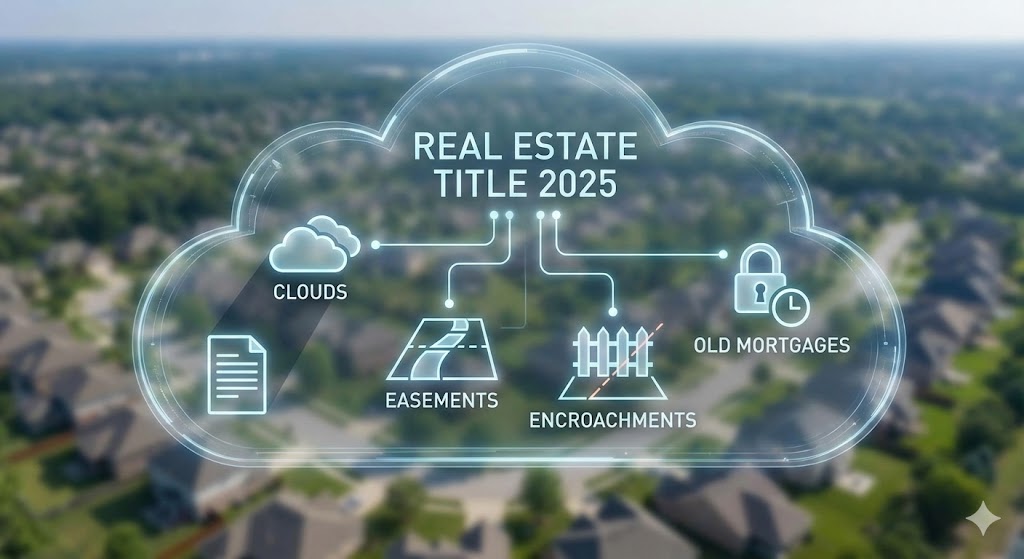
Title clouds: the basics (and why lenders care)
A “title cloud” is anything in the records—or visible on the ground—that makes ownership, boundaries, or rights to use the property less than crystal clear. Clouds don’t always kill a deal, but they can: slow underwriting, limit your buyer pool, or force last-minute price drops if they’re discovered late.
A home can be gorgeous and still hard to insure if an old lien doesn’t show a release, or a structure crosses a lot line. No insurable title = no traditional loan.
The biggest killer of deals isn’t a cloud itself—it’s when it pops up a week before closing. Sharing surveys, known easements, and payoff info early lets everyone price and plan honestly.
Cash buyers don’t have lender overlays, but reputable buyers still run title. The difference is: they can often price in risk and close even when a traditional buyer would bail.
Good starting points: ALTA consumer title basics · CFPB: What is title insurance?
Easements: types, creation, and how they end
An easement is a limited right for somebody else to use part of your land: to run power lines, cross a driveway, channel stormwater, or share a wall. Most are routine—some are deal-shaping. The key questions: who benefits, where is it, and does it conflict with how buyers want to use the property.
Power, water, sewer, telecom. Usually pre-platted and widely accepted. Building inside the easement is often restricted; relocating lines can be expensive.
Gives someone a legal right to travel across your property (or you across theirs). Critical for landlocked parcels—lenders care a lot about recorded access.
Controls water flow or protects open space. Changing grades, adding sheds, or paving over may violate rules and trigger enforcement or coverage exceptions.
Shared driveways, wells, parking, or party walls. If not recorded, they can be fragile and harder for underwriters to insure.
How easements arise
Created by deed, plat, or separate instrument. Easiest for buyers and title companies to understand and insure.
Arises when a parcel becomes landlocked after being split off. Often formalized later via agreement or court order.
Comes from long-term, open use without permission. Highly state-specific; underwriters may require quiet title to be comfortable.
Changing or ending an easement
- Release: the party who benefits signs and records a release (with a clear legal description).
- Merger: when one owner controls both properties, the easement can merge and effectively vanish.
- Abandonment/non-use: very fact-specific; just “not using it” is rarely enough without evidence.
- Relocation: sometimes allowed by statute if the new route doesn’t materially harm the easement holder—definitely a “talk to counsel” move.
Definition deep dive: Cornell LII: Easement
Encroachments: surveys, agreements, and lender expectations
An encroachment is when something crosses a boundary, setback, or easement: a fence, driveway, garage, deck, or even a roof overhang. Some are tiny and insurable; some will send an underwriter searching for coffee.
Survey types (what you actually need)
Basic footprint. Cheap, fast, and often used for refinance deals. May not catch subtle encroachments.
Confirms lines and monuments. Solid baseline for resolving fence and driveway questions for most homes.
High-detail standard for commercial and complex sites. Overkill for many houses but definitive where money and risk are big.
Common cures
Neighbors (or easement holders) formally agree to live with the condition or set a removal timeline. The agreement is recorded so future buyers can rely on it.
Move the fence, trim the eave, modify the slab, or shift the driveway. Then re-document with an updated survey and revised title commitment.
When an encroachment sits on top of an easement (like a shed over a utility strip), the utility or local government may need to sign off. Build that into your timeline.
Old mortgages & liens: payoffs, releases, and curative tips
Old liens on the record fall into two buckets: debt that’s truly still owed, and loans that were paid but never properly released. Either way, your buyer’s title company must see a clean paper trail before they’ll insure.
| Title cloud | Quick check | Likely fix | Notes |
|---|---|---|---|
| Paid loan, no release | Old closing file, HUD-1/CD, bank statements | Record satisfaction / reconveyance | Title tracks successor bank; payoff proof is key |
| MERS / assignment trail | Look up MIN or assignment chain | Servicer letter + substitute release | Let the title company coordinate; expect some back-and-forth |
| Judgment / abstract | Court docket search | Payoff or negotiated settlement; recorded release | Check homestead protections and exemptions in your state |
| Mechanic’s lien | Contractor invoices & agreements | Pay, bond off, or dispute with counsel | Deadlines are strict; don’t wait until the week of closing |
| Municipal / HOA lien | Statement of account from city/HOA | Pay plus recorded release or satisfaction | Don’t forget nuisance, weed, and code-enforcement liens |
| UCC fixture filing | UCC search (e.g., solar, HVAC) | Termination statement | Get payoff and written confirmation from the equipment lender |
If your original lender merged or failed, title companies still have playbooks for tracking down the current owner of the loan. Keep any payoff letters, closing disclosures, and bank records—you’d be surprised how often a 10-year-old PDF saves a deal.
Title insurance: commitment, exceptions, and endorsements
A lender’s policy protects the lender. An owner’s policy protects you (or your buyer). Both are anchored in the title commitment, which is basically the underwriter’s term sheet for what they will—and won’t—cover.
Shows who owns the property, proposed insureds, policy amounts, and the legal description. Think of it as the “headline” of the deal.
Lists what must be done before issuing the policy: payoffs, releases, affidavits, surveys, probate docs, entity documents, etc.
Outlines what’s not covered: easements, restrictions, encroachments, and anything the insurer doesn’t want on their hook.
Endorsements that often show up
- ALTA 9 series (restrictions, easements, encroachments) — narrows certain exceptions for violations.
- ALTA 17 series (access) — insures that the property has legal access to a public road.
- Survey / encroachment endorsements — rely on a recent acceptable survey to give buyers more coverage.
Curative workflows: practical timelines (and backup plans)
Curative work is everything the title team does to turn “clouded” into “clear enough to insure.” You don’t want ten parallel projects; you want one clear sequence with time boxed steps and a plan B if something drags.
| Step | Owner actions | Who helps | Typical time | Pro tips |
|---|---|---|---|---|
| 1) Gather evidence | Prior policy, survey, HUD-1/CD, payoff letters | Title company, prior closer | 3–7 days | Track all name variations and old addresses |
| 2) Order survey (if needed) | Boundary or ALTA as recommended | Surveyor | 1–3 weeks | Ask for rush pricing and digital files if complex |
| 3) Draft agreements | Boundary/use/encroachment documents | Attorney, neighbor, utility, HOA | 1–4 weeks | Attach exhibits (survey snippets) so everyone is literally on the same page |
| 4) Payoffs & releases | Request payoff statements; prepare to wire | Title, lenders, HOA, city | 1–2 weeks | Verify wiring instructions by phone with a known-good number |
| 5) Update commitment | Send fully signed docs to underwriter | Title underwriter | 2–5 days | Get endorsements and remaining exceptions in writing |
| 6) Close & record | Sign with updated figures | Title/escrow | 1 day | Confirm e-recordings show up in the county index |
If you’ve got a hard date—job relocation, foreclosure, probate timelines—set up a cash-offer plan B in parallel. That way, if an easement consent or release stalls, you still have a viable closing path instead of starting from zero.
Quiet title: when a court order is the cleanest fix
Quiet title is a lawsuit used to settle who owns what, once and for all. It’s often the tool of last resort: think forged deeds, missing heirs, conflicting legal descriptions, or long-running adverse-use situations.
An attorney files a complaint, serves anyone with a potential claim, may request a new survey, possibly publishes notice to unknown parties, and asks the court for a judgment. Title underwriters then lean heavily on that final order.
Think months, not days. Costs vary widely by state and complexity. For some sellers, it’s worth doing; for others, selling to a cash buyer who can tackle the process after closing is more realistic.
References: Cornell LII: Quiet title action · U.S. Courts (general process overview)
This guide is educational. Laws, timelines, and underwriting standards vary significantly by state and by title company. Always consult your own real-estate attorney and licensed title professional before making decisions.
Compare paths: list, FSBO, or cash sale with clouds
| Path | Typical speed | Certainty | Title flexibility | Best for |
|---|---|---|---|---|
| Traditional listing | 30–60+ days after going live | Market-driven | Low (strict lender & underwriting) | Mostly clean title, standard easements only |
| FSBO | 30–90+ days | Highly variable | Low (same underwriting; more DIY) | Experienced sellers comfortable managing title/details |
| Cash sale | 7–30 days (sometimes faster) | High once agreement is signed | Higher (fewer lender overlays; risk priced in) | Meaningful clouds, deadlines, or “project house” situations |
State guides: Texas · Florida · Ohio · Georgia · North Carolina
Copy-ready checklists & scripts for clouded title
Seller prep checklist (title issues)
- Locate prior owner’s policy, old surveys, permits, HOA docs, and any recorded easements.
- List visible encroachments (fences, sheds, drives) and take labeled photos.
- Request payoff letters and HOA / municipal statements as soon as you know you’ll sell.
- Order a boundary survey if your last one is old or missing—and you suspect line issues.
- Create one shared folder with all PDFs for your agent, buyer, and title company.
- Decide on a “walk-away” date/number where you’d pivot to a cash buyer if needed.
Under time pressure? You can always get a cash offer in parallel while the curative work runs.
Plain-English script for buyers & agents
“We’re aware of a few title items and we’re in front of them. We’ve uploaded the prior policy, survey, and disclosures. An encroachment / easement agreement is in progress with [neighbor/utility] and we expect signatures by [date]. If that slips, we’re prepared to offer a credit of $X or pivot to a cash closing by [backup date]. Please confirm what your lender and title underwriter will accept—survey, agreement, and ALTA endorsements—so we can line everything up.”
- IDs with all name variations; any prior names used on the property.
- Prior owner’s or lender’s policy and the old closing statement (HUD-1/CD).
- Recent payoff letters, HOA account statements, city lien searches.
- Any recorded easement or encroachment agreements and affidavits.
- Most recent survey (PDF; CAD/DWG if available) and labeled photos.
- Assuming a “handshake” driveway agreement is enforceable without recording.
- Relying on a 20-year-old survey without checking whether monuments still match reality.
- Paying off liens but never obtaining and recording formal releases.
- Ignoring HOA or city notices until you see them show up on the final HUD.
Authority resources & further reading
Explore state guides & as-is offers:
Texas · Florida · Ohio · Georgia · North Carolina · Get a cash offer
Frequently asked questions
Will a small utility easement kill my sale?+
Usually not. Most neighborhoods have recorded utility easements and they’re widely insured—so long as they’re disclosed and don’t conflict with additions a buyer is planning.
Do I need quiet title for every encroachment?+
No. Many encroachments are resolved with a recorded boundary or encroachment agreement, or by physically moving the item. Quiet title is for disputes that simple documents can’t settle.
What if my old lender no longer exists?+
Title companies maintain maps of bank mergers and loan transfers. With payoff proof—old HUD-1/CD, payoff letters, or statements—they can often get a substitute release from the successor.
Can I sell while curative work is still in progress?+
Yes, if everyone buys into the timeline. Buyers, their lender, and the underwriter must agree that the needed documents will be ready before closing. Contracts should reflect realistic dates and contingency plans.
Will title insurance cover future boundary disputes?+
Sometimes. It depends on the policy, endorsements, and what the survey shows. Endorsements like ALTA 9 and survey/encroachment coverage can help, but you must ask your title professional what’s available in your state.
Is this legal or tax advice?+
No. This is an educational overview. Always consult your own attorney, tax advisor, and licensed title company before relying on anything for your specific property.
Ask us anything about your title clouds
Easements, encroachments, probate, foreclosure clocks, or “I’m not even sure what this lien is”— send it our way. We’ll review your situation and give you straight, plain-English options: curative path, list, or as-is cash.
Need to close with title clouds?
We buy homes nationwide, as-is—even with easements, encroachments, old liens, or probate issues. No showings. No repairs. Clear math.