
Seller Stuck in 2021: Why Buyers Are Walking in a Cooling Market
Buyers aren’t ghosting because they’re fickle — they’re doing math. When sellers cling to pandemic-era pricing, deals stall, inspections get nitpicky, and more contracts die on the table. This guide blends fresh data with plain-English strategy so you can sell now without donating months of your life to price cuts and cancellations.
Short version: 2025 is not 2021. Mortgage rates have eased into the mid-6% range (about 6.27% this week), but that’s still roughly double the pandemic lows, so monthly payments remain heavy. Home-price growth is cooling and the share of listings with price cuts is elevated. Those forces create a buyer mood we call “careful, not desperate.” Result: more negotiations, more second thoughts, and more canceled contracts when sellers refuse to adjust.
At the peak of summer, roughly 58,000 U.S. home-purchase agreements fell apart in July, equal to 15.3% of homes that went under contract — the highest July fallout since Redfin began tracking in 2017. Cancellations were concentrated in Texas and Florida, where buyers have more choices and higher carrying costs.
Contract cancellations trend
1) What the data says: buyers are walking more often
Contract fallout hit a record July level. Redfin tallied a 15.3% cancellation rate in July 2025 — about 58k deals — driven by affordability and a cooling psychology. Metros in Texas and Florida led the pack, with San Antonio topping the list at 22.7%, Fort Lauderdale 21.3%, Jacksonville 19.9%, Atlanta 19.7%, and Tampa 19.5%. Source
Price cuts became normal again. Realtor.com reports 17.5% of active listings cut price in March — the highest March share in their dataset since at least 2016 — and reductions stayed elevated into spring. Source
Home-price growth cooled. The S&P CoreLogic Case-Shiller index showed a 2.3% YoY national gain in May, down from 2.7% in April — among the slowest prints in roughly two years. Source
Rates eased, but affordability gap remains. Freddie Mac’s PMMS has the 30-year fixed in the mid-6% range, reported around 6.27% this week by major outlets. PMMS
Builders blinked first. NAHB and industry coverage show incentives are widespread and roughly 38–39% of builders have been cutting prices (average ~5–6%), which siphons buyers away from resale listings that won’t budge. Reuters/NAHB • Realtor.com (NAHB)
2) The “2021 anchor”: a psychology that kills deals
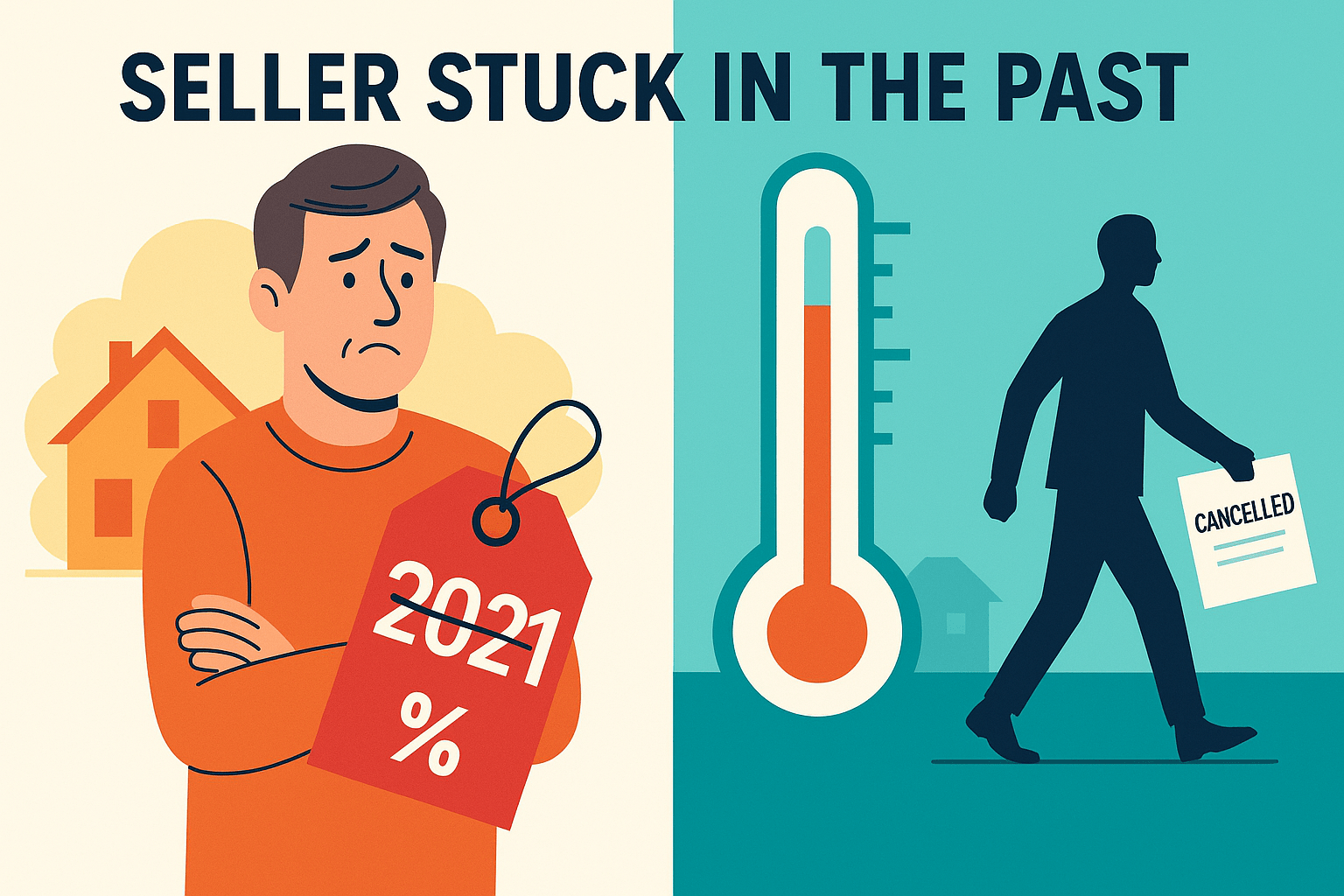
Anchoring is clinging to a starting number — like your neighbor’s 2021 sale price — and treating it as gospel. Sellers who anchor to peak-cycle comps often overprice by a few percent and assume “the right buyer” will show up. In a cooling market, that buyer doesn’t rush, and your first two weeks (when the listing gets the most eyeballs) slip by without strong offers. What follows is often death by a thousand paper cuts: a small reduction, then another; an inspection credit; a financing extension; then a cancellation while you’re 45–60 days older. Each cut becomes a billboard saying “We’ll take less.”
Bottom line: in metros with elevated fallout (San Antonio, Fort Lauderdale, Jacksonville, Tampa), the 2021 anchor is expensive. Use current comps and local proof from sellers like you instead of nostalgia.
3) The only equation buyers care about: the monthly payment
A 30-year fixed at around 6.27% creates a very different payment than ~3% did. Even if your sticker price hasn’t changed, the all-in monthly has. That’s why we see cautious buyer behavior despite some rate relief. Meanwhile, price momentum is softer; Case-Shiller’s 2.3% YoY May print removes the “buy now or be priced out” urgency. If prices aren’t racing away, buyers don’t stretch to “win” — they negotiate, or they walk.
Want to remove friction? Read our remote-closing guide for out-of-state owners and our Senior Sellers Playbook for practical steps that keep deals together.
Next: use the interactive Pricing Reality App below to see, in real dollars, what “trying your number” for a few extra weeks actually costs compared with accepting the offers buyers are already putting on the table.
What waiting for “your number” really costs
Plug in the number you want, the offers or agent opinions you’re actually seeing, and your daily carrying cost. We’ll show how much net you keep (or lose) by holding out for a 2021-style price versus accepting a realistic 2025 offer now.
Assumption: in both scenarios, you eventually close near the realistic number buyers will actually pay. The question is how much extra time and carrying cost you burn before getting there.
Scenario A · Hold out on 2021 price
$0
Scenario B · Price at reality now
$0
Use this as a starting point alongside what your agent is telling you — or as a sanity check if you’re selling direct.
4) Inspections, insurance, and the “deal-fatigue” domino
In the frenzy, buyers waived contingencies. In a cooler cycle, they treat inspections like an options contract on your house. If inspections reveal a near-end-of-life roof or aging HVAC, they’ll re-trade the price — and if you resist, cancellations spike. Builders blunt this with rate buydowns, credits, and price cuts; industry surveys show incentives are widespread and roughly two-fifths of builders cut prices this year. Resale listings that won’t play ball lose buyers to new construction.
Insurance is the other wild card in places like Florida and along the Gulf/Atlantic coasts. When a premium quote jumps at underwriting, it can torpedo DTI and confidence at the eleventh hour — another reason buyers walk in those markets. If your county’s median days on market trends above national, expect tougher negotiations and more walkaways.
Pre-disclose known issues, package recent service receipts, and consider a credit menu (e.g., $6,000 toward rate buydown, closing costs, or repair escrow). It keeps deals from melting at inspection.
5) Where walkaways spiked (and why)
Texas & Florida led cancellation rates. Redfin’s metro list shows: San Antonio (22.7%), Fort Lauderdale (21.3%), Jacksonville (19.9%), Atlanta (19.7%), Tampa (19.5%). These Sun Belt markets have abundant new construction and rising inventories, which give buyers choices and confidence to walk away. Local proof matters: browse our state-by-state reviews and see how we’ve structured credits, timelines, and as-is closings to hold deals together in tough markets.
6) A no-drama strategy for sellers who want certainty
Price to win the first two weeks
The first 14 days deliver the biggest buyer pool. Price inside today’s comp band (not last cycle’s). Stack showings and momentum early — this is how you avoid the cut-cut-cancel loop. See real outcomes in our testimonials.
Fix small stuff, disclose big stuff
Pre-inspection + receipts build trust and remove renegotiation fuel. If a big ticket item exists, price it in and disclose. That’s how you keep deals from melting at inspection.
Offer a credit menu
Buyers love choice. A rate buydown often “costs” the seller less than a headline cut while delivering more payment relief to buyers — a tactic builders are using widely.
Consider a certain buyer
Cash + as-is = no lender delays, fewer contingencies, and a move-out timeline you control. If you’re relocating or managing an estate, see our guides for remote closings and senior downsizing.
Mind the calendar
Seasonality still matters. In slow quarters, consider credits vs. long days on market. When you’re ready, get a baseline cash offer to sanity-check your strategy.
Have a Plan B ready
Line up a fallback offer so you never lose momentum. Treat it like an insurance policy against cancellation risk.
7) The pricing playbook we use with sellers (fast & data-based)
- Start with absorption, not 2021 comps. If a sizable share of listings are cutting price nationally in spring conditions (e.g., 17.5%), over-listing is a shortcut to weeks of dead air. Realtor.com
- Track rates weekly. PMMS in the mid-6% range (about 6.27% this week) shapes what buyers can afford — and whether buydowns pencil. Freddie Mac PMMS
- Watch price momentum (Case-Shiller). Slower YoY gains = less FOMO, more negotiating. S&P DJI press
- Borrow builder tactics. Temporary buydowns, closing-cost credits, or repair escrows beat a clumsy headline cut. Reuters/NAHB
- Decide your certainty premium. Compare a fast, certain cash sale vs. a retail listing with 60–90 days of risk. Who we are • Get your offer
How selling to Local Home Buyers USA works
Skip the price-cut drip. See how our simple process works in under two minutes.
Get monthly market intel (free, expert-curated)
We publish clear, data-driven updates (no fluff, no spam). Join thousands of sellers who get early looks at pricing trends, incentives, and timing strategies by state.
FAQs & myths
“If rates are easing, shouldn’t buyers flood back?”
Rates eased to the mid-6% range (~6.27% this week), but affordability is still far from 2021. With home-price growth cooling, urgency is muted, so buyers negotiate more and walk away more often.
“Are cancellations really elevated?”
Yes. July 2025 saw about 58,000 cancellations — 15.3% of homes under contract — Redfin’s highest July since tracking began in 2017, with Texas and Florida metros leading.
“What converts buyers better: a price cut or a credit?”
Credits like rate buydowns or closing-cost help often convert better than small headline cuts because they directly reduce the buyer’s monthly payment. Builders use these incentives widely.
“Should I list or accept a cash offer?”
It depends on your timeline and risk tolerance. If your market shows frequent price cuts and longer days on market, de-risking via a certain cash buyer can net more after carrying costs and stress. Use the Compare drawer to estimate both scenarios.
About the author & reviewer
Local Home Buyers USA Editorial Team
We buy homes nationwide and publish plain-English market explainers with transparent sourcing. For remote owners, see Remote Closing. For downsizing and timelines, browse the Senior Sellers Playbook. Explore state-by-state reviews or learn more about us.
Fact-checked with primary sources
Rates and price indices: Freddie Mac PMMS; S&P CoreLogic Case-Shiller. Market activity & cancellations: Redfin. Price-cut trends: Realtor.com Research. Builder incentives/pricing: Reuters/NAHB; Realtor.com—NAHB.
Data sources, permissions & license notes
- Freddie Mac PMMS: weekly mortgage rate survey for public informational use; terms/methodology at PMMS. freddiemac.com/pmms
- Redfin market analytics: public report & data center used under fair use for commentary; attribution provided. Report
- Realtor.com Research: monthly trends report; attribution provided. Report
- S&P CoreLogic Case-Shiller: cited via official press release; no raw redistribution here. Press
- NAHB/Reuters coverage: builder sentiment, price cuts, incentives; attribution provided. Article
Trademarks are the property of their respective owners. All third-party data remain under their publishers’ licenses/terms. We cite and link rather than republish.
Bottom line
Buyers aren’t flaky — they’re disciplined. With slower price growth, elevated price reductions, and affordability still stretched, buyers say “no” more often. If your goal is certainty, align price to today’s market, reduce friction with credits and clear disclosures, and consider a buyer who can close without drama. If you want a zero-obligation number that lets you compare options apples-to-apples, get your cash offer and keep your timeline in your control.