
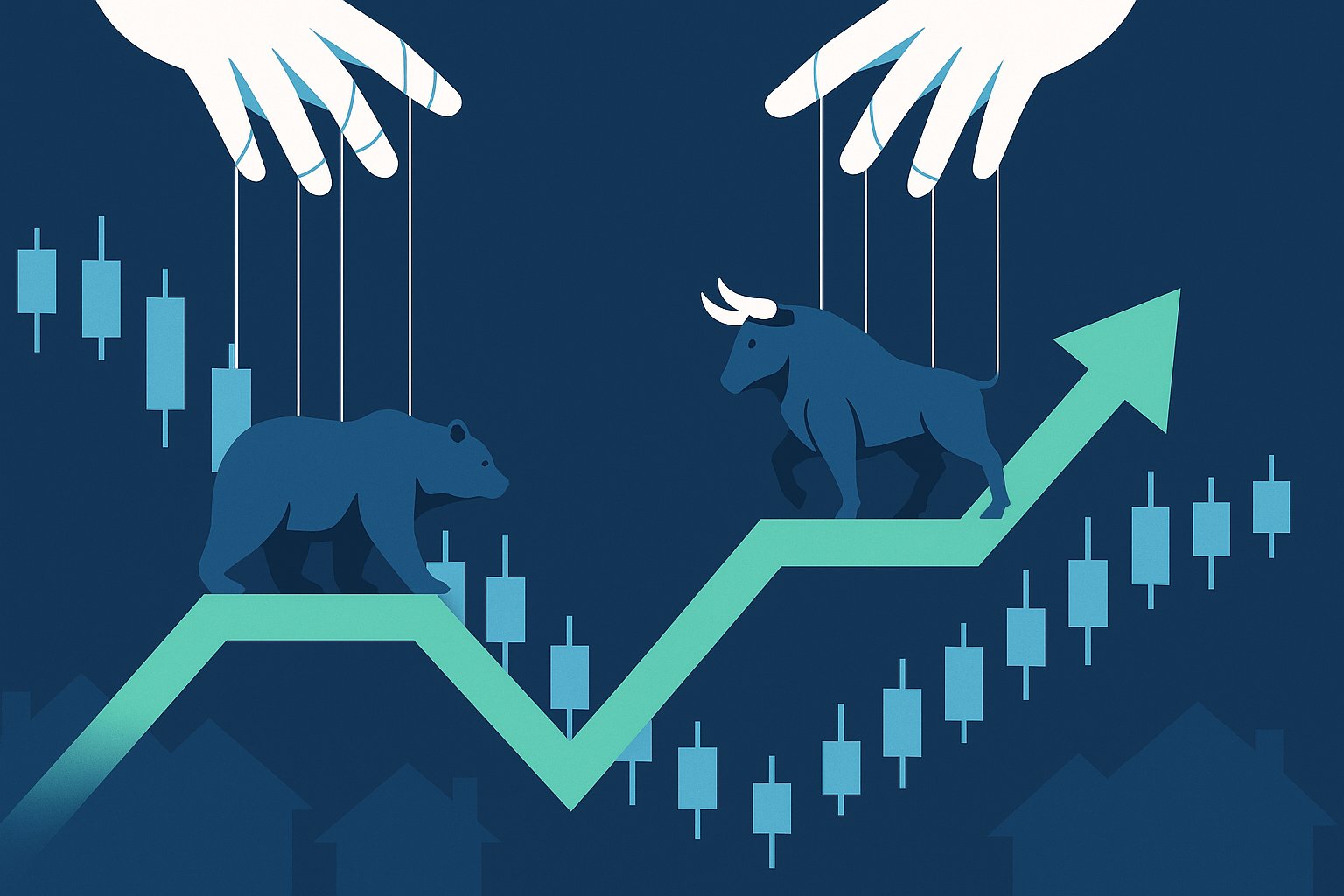
Short version: the latest dip doesn’t prove that “the market is rigged.” It proves that liquidity, leverage, and fear still drive price action — only now those forces are amplified by algorithms and real-time data.
Smart money isn’t shocked by red screens. It’s waiting for them. And increasingly, the same AI that reads stock-market panic is watching housing data — days on market, price cuts, mortgage resets — to identify motivated sellers long before headlines catch up.
1. Why every dip feels like manipulation
When your feed is stacked with red charts and “breaking” banners, it’s natural to ask if someone is pulling strings behind the scenes. Prices gap down at the open, rallies fail at the same levels, and your favorite AI names seem to fall in sync.
Here’s what’s actually happening most of the time:
- Quant funds and risk models hit the same thresholds at the same time. When volatility jumps or interest-rate expectations change, similar models de-risk in unison.
- Passive flows and options hedging amplify those moves. Dealers who sold upside calls suddenly have to sell shares to stay hedged; index funds rebalance whether you like it or not.
- Retail panic lags smart money by hours or days. By the time it “feels” manipulated, institutional money has often rotated weeks earlier.
That doesn’t mean there’s never bad behavior or coordinated trading. It means that most of what looks like a conspiracy can be explained by rules-based systems reacting to the same data in real time.
“The market is a device for transferring money from the impatient to the patient.” — Warren Buffett
In 2025, swap “impatient” with “headline-driven” and “patient” with “data-driven,” and you’re very close to how this game is actually played.
2. Smart money, smart machines, and the new “tape”
In the old days, traders watched the ticker tape. Today, the tape is a blended stream of order flow, social sentiment, volatility surfaces, and macro data — all digested by models in milliseconds.
That’s not sci-fi; it’s just profitable:
- Sentiment crawlers read X, Reddit, and news headlines for shifts in fear and greed.
- Machine-learning models spot patterns in options positioning and ETF flows that used to take humans days to see.
- Execution algorithms use that insight to feed orders into the market with surgical precision, often during thin liquidity windows.
To the naked eye, that feels like manipulation. Under the hood, it’s closer to hyper-efficient pattern recognition.
3. Where stocks and housing quietly intersect
So why is a company called Local Home Buyers USA talking about stock-market dips?
Because the same forces that move the S&P 500’s candles impact your household balance sheet:
- When portfolios drop, some households feel poorer and pull back on home upgrades or moves.
- Higher rates hit both equity valuations and mortgage affordability at the same time.
- In certain zip codes, a spike in margin calls and layoffs turns into an increase in “I have to sell” conversations within months.
That’s where PropTech enters the chat. At PropTechUSA.ai, our research lens watches:
- Local listing inventory and price cuts;
- Time-to-close trends and fall-through rates;
- Owner distress signals like tax delinquencies, code issues, and pre-foreclosure filings.
When risk assets wobble and those housing-tape metrics move in sync, we know something important: the market isn’t just repricing stocks — it’s repricing people’s plans.
4. How PropTechUSA.ai reads a “dip” differently
Our world isn’t about calling tops and bottoms in the S&P. It’s about asking a more practical question:
“If this volatility persists, which homeowners will need certainty more than they need a bidding war that may never appear?”
From the PropTechUSA.ai research desk, a stock-market dip often coincides with:
- Rising inbound calls from owners who were “thinking about selling next year” and now prefer a fast, as-is cash offer.
- Increasing spreads between list prices and realistic closing prices — especially in markets where rates hit stretched buyers the hardest.
- Faster acceptance of certainty-based offers from buyers who can close even if bank lending standards tighten.
In other words, while many investors argue on social about manipulation, we’re watching the real-world impact on sellers who can’t afford to wait 6–9 months for conditions to improve.
5. Is it rigged… or simply ruthless?
So, is the market manipulated? At the margins, sure — bad actors exist. But the larger, boring truth is this:
- The game is tilted toward those with data, discipline, and time horizons longer than a news cycle.
- Short-term moves are dominated by risk controls, not narratives.
- The crowd tends to act after the systems that truly move size have already repositioned.
If you look up after a 7–10% drawdown and see institutions quietly accumulating quality names again, that’s not proof of a cabal. It’s proof that they respect volatility as a feature, not a bug.
6. What this means if you own a home in 2025+
Here’s where things get concrete for homeowners and investors who live in the real world — not on a trading desk.
When markets wobble, optionality shrinks
In a roaring bull market, you can overprice your listing, wait it out, and still find a buyer. In a choppy, higher-rate regime, that strategy can backfire fast.
If your life events are non-negotiable — job change, divorce, inheritance, medical bills — you’re not managing a portfolio. You’re managing time risk.
Why some sellers choose “cash-plus-certainty” over “maybe more later”
- Certainty beats optionality when your debt, carrying costs, or stress levels are compounding faster than hoped-for price appreciation.
- As-is cash offers can sidestep repairs, showings, and fall-through risk at precisely the moment the market is least forgiving.
- Data-backed pricing from platforms like PropTechUSA.ai can anchor expectations in reality, not yesterday’s bull-market comps.
That’s the service layer Local Home Buyers USA sits in: taking noisy macro volatility and turning it into clear choices for individual owners.
7. A practical playbook for this kind of market
If you’re watching both your brokerage account and your home value with more anxiety than usual, use this checklist:
- Audit your time horizon. If you must sell within 3–6 months, you’re in a different category than a “someday seller.”
- Separate what you want from what the market will likely pay. Look at actual closed sales and price cuts, not just list prices.
- Stress test your plan. Ask, “If prices soften another 5–10% and days-on-market stretch, can I live with that?”
- Compare paths side by side. Traditional listing vs. as-is cash offer vs. renting vs. holding — including time, stress, and repair costs.
8. Bottom line: the “rigging” you can actually use
Maybe the most honest answer to our headline question is this:
The system is tilted — not toward villains in smoke-filled rooms, but toward whoever respects data, risk, and time more than narratives.
For some people, that means calmly buying quality stocks when fear spikes. For others, it means trading a theoretical top-tick sale price for a guaranteed outcome on their largest asset: their home.
If you’re in the second camp and want to see what a cash-plus-certainty offer looks like in your zip code, we built an easy next step.
See a side-by-side of listing vs. a certainty-based offer from Local Home Buyers USA — powered by PropTechUSA.ai market data.