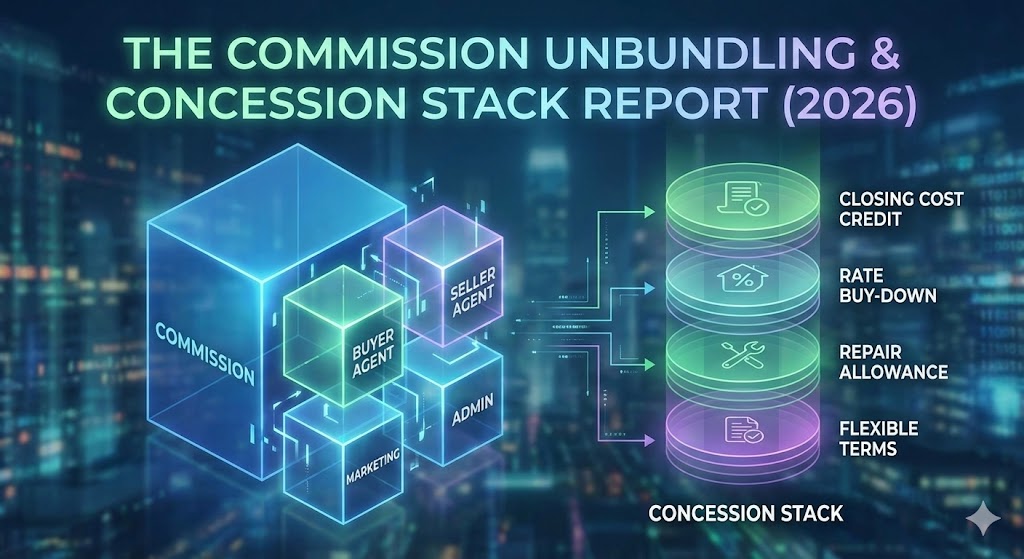
The Commission Unbundling & Concession Stack Report (2026)
The old era had one primary number: sale price.
The new era has a different primary number:
Net Certainty Price — what you actually keep after commissions, credits, repairs, buydowns, delays, and fall-through risk.
Commission “unbundling” doesn’t just change how agents are compensated.
It changes how buyers write offers — and how sellers should evaluate them.
Price is now only the headline. The real outcome lives in the stack.
Bloomberg-grade takeaway: every offer is a structured product.
The winning offer is the one with the highest probability-adjusted net — not the loudest headline.
Tip: Swiping is mobile-native; arrows appear on desktop automatically.
Executive summary
When commissions are treated as a default, offers can be compared like a single number:
price.
When commissions and credits become explicit, a “price” is no longer a price — it’s a bundle.
In the new protocol, buyers increasingly structure offers like a package:
price + agent compensation terms + credits + repairs + buydowns + timeline conditions.
This package can look “high” on the first line while being weak at the bottom of the page.
Your goal as a seller is not to choose the highest offer.
Your goal is to choose the offer with the highest Net Certainty Price.
Net Certainty Price = expected net proceeds minus the stack of concessions, fees, and timeline risk.
What you get in this report:
Offer Stack Normalizer: converts any offer into a single “Net Certainty Price.”
Commission Visibility Panel: models “seller pays / buyer pays / split” to reveal the real net.
Concession Gravity Gauge: estimates how quickly credits and buydowns “pull” on net proceeds.
Fastest seller advantage: benchmark certainty early.
Use a transparent baseline (our Glass-Box approach)
and compare outcomes across selling paths.
The new offer protocol: headline price vs stack reality
Here’s what changed at the strategy layer:
more buyers now arrive with an explicit compensation structure in mind, and the negotiation is migrating from “one number” to “many levers.”
That means your evaluation process must upgrade.
The three-stage negotiation (where sellers lose net)
Stage 1 — The headline: price looks attractive.
Stage 2 — The stack: credits, repairs, buydowns, and fee assignments show up.
Stage 3 — The timeline: delays create leverage (the quietest price cut).
Stage 3 is why commission unbundling and concessions are inseparable: a stackier deal has more points of failure.
That’s the same logic behind the Closing Friction Tax.
The seller who wins in 2026 is the one who can say:
“I don’t negotiate on vibes. I negotiate on normalized net.”
Offer Stack Normalizer: compute Net Certainty Price (interactive)
Plug in an offer and let the module normalize it.
This is not legal or financial advice — it’s a decision tool to compare outcomes consistently.
ModuleNet Certainty Price calculator
Answer
—
Net Certainty Price
—
Adjust inputs to compute the Net Certainty Price and the stack load.
VisualOffer Stack Waterfall (deductions)
Listing agent$—
Buyer agent (seller-paid)$—
Seller credits$—
Repairs$—
Buydown / points$—
Delay + restart risk$—
This visual shows where your net proceeds are being “consumed” by the stack.
VisualStack Signal Radar (certainty vs drift)
The radar tightens when the stack is lighter and timelines are cleaner — and lights up “drift” when concessions, delays, and fall-through risk rise.
Commission Visibility Panel: why “who pays” changes the whole offer
In a bundled world, compensation was often invisible to the seller because it was treated as default.
In an unbundled world, compensation becomes part of the offer design — which means sellers must evaluate it as a line item.
Here’s the hidden effect sellers miss
When the buyer can’t or won’t pay their agent out-of-pocket, compensation pressure frequently moves into the only flexible bucket:
seller credits. That’s why concessions and compensation structure behave like communicating vessels.
Seller language that protects net:
“We’ll consider any compensation structure — but we compare offers on normalized net proceeds and certainty. If compensation is requested, the offer needs to hold on price, timeline, and concessions.”
Concession Gravity Gauge: how quickly credits pull down net
Sellers often treat concessions as “small” because they don’t change the headline price.
But concessions don’t just reduce net — they also reduce your leverage because they normalize the idea that net is flexible.
ModuleConcession Gravity gauge
Output
—
This gauge shows concessions as a percentage of price (a quick “gravity” proxy).
Rule of thumb: once concessions feel “normal,” they become repeatable. The best defense is a stack-aware counter:
adjust price, shorten timelines, or reassign which bucket carries the cost.
If your property also carries operational friction (HOA docs, title, probate, insurance), concessions can compound with time.
That’s why we use the Closing Friction Tax lens.
The seller playbook: win the stack negotiation without losing the deal
1) Stop comparing offers on price. Start comparing on Net Certainty Price.
If you do nothing else, do this one thing: normalize every offer into the same scoreboard.
It instantly reveals which offers are “loud” and which are actually strong.
2) Pre-commit to a concession budget (so the stack can’t drift)
A concession budget is a defensive wall. It’s not “being difficult.”
It’s how professionals prevent a deal from turning into a blank check during inspection.
3) Tie any concession to certainty
Credit? Great — shorten the close.
Buydown? Great — reduce inspection scope or cap repair requests.
Compensation request? Great — keep price strong and remove contingencies.
4) Benchmark a certainty path early
The easiest way to negotiate from strength is to have a clean alternative in your pocket:
a transparent baseline offer you can compare against.
That’s the logic behind our Glass-Box Cash Offer.
In a stack market, the best seller is the one who can calmly say:
“We’re flexible — but we price flexibility.”
Flexibility without pricing is just leakage.
What does “commission unbundling” mean for sellers?
It means compensation terms can be more explicit in the offer design.
Sellers should evaluate “who pays what” the same way they evaluate credits, repairs, and timelines:
as part of the net outcome.
Does a higher price always win?
Not anymore. A high price can hide a heavy stack:
credits, repairs, buydowns, fees, longer timelines, and cancellation risk.
The winning offer is the highest Net Certainty Price.
If the seller pays less commission, do concessions go down?
Not always. Sometimes compensation pressure migrates into credits/buydowns.
The best approach is to normalize and compare offers — not assume.
How do I protect myself from “stack drift”?
Set a concession budget, tie concessions to certainty (shorter close, fewer contingencies), and benchmark an alternative
so you’re negotiating from strength.