LOCAL HOME BUYERS USA — powered by the research of PropTechUSA.ai
Report • Slug: closing-friction-tax-report
TITLE • HOA • PROBATE • PERMITS • PAYOFFS • TIMELINE RISK
The Closing Friction Tax Report: The Invisible Costs That Kill Deals in 2026
Most sellers think they’re selling a house. In reality, they’re selling a closing.
And in 2026, the market is quietly repricing something most homeowners never modeled:
closing friction—the documentation, title, governance, and timeline complexity that turns a “great offer” into a dead contract.
This report introduces a single concept you can use to protect net proceeds and reduce fall-through risk:
the Closing Friction Tax.
It’s the all-in cost of delays, re-trades, extra concessions, and deal restarts caused by friction that lives outside your renovations.
Understand the friction tax and you stop negotiating “price vs pride” — you start engineering certainty.
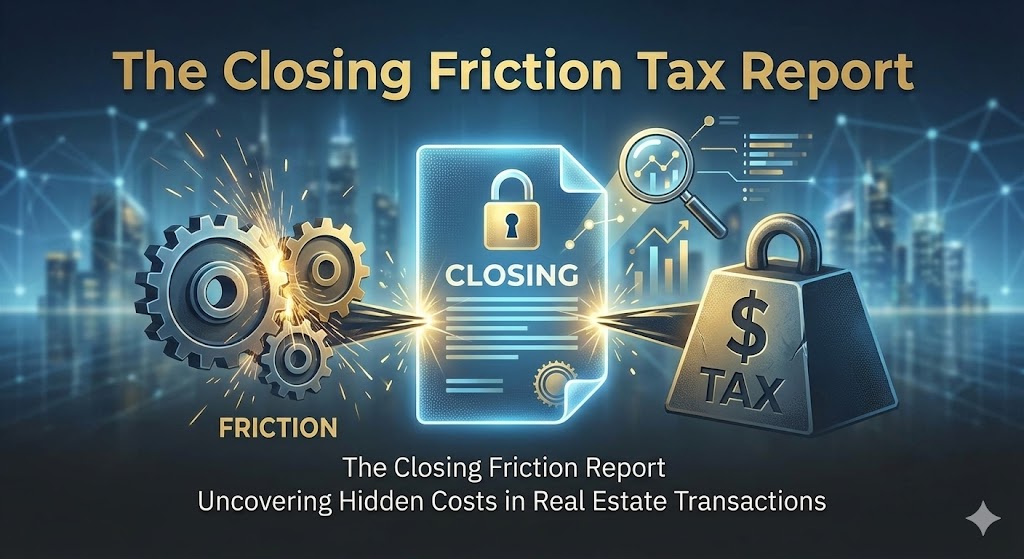
Featured visual: The market is splitting by clearance—not just condition.
This report shows how liens, probate, HOA documents, permit gaps, and payoff timelines become a second negotiation layer.
Tip: On mobile, swipe the ribbon like a terminal tape. On desktop, scroll sideways (or use arrows).
Executive summary
In 2026, deals don’t just fail because a roof is old. They fail because the closing system can’t clear the file:
missing authority, unclear ownership, delayed HOA documents, liens that must be released, payoff letters that arrive late,
permits that don’t match the structure, insurance binders that can’t be issued, or underwriting conditions that trigger
last-minute renegotiations.
That creates a hidden tax on sellers: the longer a deal drags, the more leverage shifts to the buyer.
Not always because the buyer is aggressive — because time creates asymmetry. Time increases uncertainty.
Uncertainty increases fall-through risk. Fall-through risk forces concessions. Concessions become a shadow price cut.
That chain reaction is the Closing Friction Tax.
The modern negotiation is no longer “price vs condition.” It’s “certainty vs variance.”
When variance rises, the buyer pays less (or walks). When certainty rises, the seller keeps net (and closes faster).
Three tools in this report:
Closing Friction Index (CFI): a quick score that classifies your file as retail-clear vs friction-heavy.
Underwriting Radar: a visual map of where friction turns into concessions and delays.
Friction Tax Ledger: a practical estimator that turns drift + risk into dollars.
Seller shortcut: If your CFI is high, you don’t need more showings—you need a better outcome.
Compare paths here: Ways to Sell.
If you want a transparent benchmark, request a Glass-Box Cash Offer.
What is closing friction?
Closing friction is anything that adds time, uncertainty, or legal complexity to the transfer of ownership.
It’s not “how it looks.” It’s “can it clear.”
The Closing Friction Tax (a simple definition)
Friction Tax = Delay Cost + (Fall-through Probability × Restart Cost) + Extra Concessions.
Even if you never write it down, buyers and lenders price it into their behavior. When the file feels messy, approval slows,
and the negotiation becomes a moving target.
What friction looks like in real life
Title friction: liens, unreleased mortgages, judgments, missing documents, boundary/encroachment issues.
Timeline friction: payoff letters, municipal compliance, permit research, missing disclosures.
This is why our broader thesis matters:
the market is splitting into retail-clear and friction-heavy lanes
(End of the Retail-Ready Era).
And within those lanes, deals are increasingly clearing through terms
(Concession Economy).
Closing friction is the mechanism that forces terms to exist.
A home can be “retail-ready” visually and still be friction-heavy operationally.
In 2026, operational readiness is value. Buyers pay for clearance.
CFI: The Closing Friction Index (interactive)
The CFI is a practical scoring model (not legal advice).
Check what applies. The module will estimate a score and label your lane:
Retail-clear, Friction-moderate, or Friction-heavy.
ModuleCFI Score (0–100)
Known lien or unpaid balance Taxes, HOA, judgment, contractor, or an unreleased mortgage.
If your CFI is low, retail can perform smoothly. If your CFI is moderate, friction can snowball into concessions.
If your CFI is high, your biggest risk is not “getting an offer.” It’s getting a closing.
That’s when certainty becomes a rational product, not an emotional compromise.
Underwriting Radar: where friction becomes leverage
Buyer leverage usually peaks after inspections and underwriting conditions arrive—but before you’re sure you can replace the buyer.
The radar below visualizes that timing: friction points show up as blips, and time is the scan.
Each unresolved blip increases the odds of delay, re-trade, or cancellation.
ModuleUnderwriting Radar (visual)
The radar updates based on your CFI selections. Motion is purely visual and can be disabled with the Motion toggle.
The Friction Tax Ledger: turn delays and risk into dollars
Many sellers underestimate the cost of “just another week” because the costs are distributed:
mortgage, utilities, taxes, insurance, HOA, vacancy risk, and the silent cost of leverage.
The ledger below estimates the visible portion of the friction tax so you can compare outcomes instead of vibes.
ModuleFriction Tax Ledger (interactive)
Output
—
Adjust the inputs to estimate the visible portion of your friction tax.
Decision rule: If this number is meaningful, benchmark certainty early.
Compare paths here: Ways to Sell.
Or get a transparent baseline: Get an offer.
The Clearance Playbook: reduce friction before the buyer weaponizes it
Most sellers treat closing as an administrative step. High performers treat it as a competitive advantage.
The goal: make your transaction easier to underwrite, insure, and clear—before contingencies become leverage.
Step 1: Build a “Clearance Packet” (one hour that can save weeks)
Authority: who signs, and proof they can sign (trust, executor docs, POA as applicable).
Step 3: Choose your lane before the market chooses it for you
Retail can still win if you’re retail-clear. But if you’re friction-heavy, retail becomes a longer timeline with higher variance.
Use Ways to Sell + PVI
to model certainty vs upside.
Step 4: If probate is involved, treat time like money (because it is)
Probate and inherited properties often carry the highest friction profile. Macro context:
Silver Tsunami / aging owners.
When certainty wins: the point where a clean benchmark beats retail variance
The real decision is not “cash vs retail.” It’s “expected net outcome vs variance.”
When the expected friction tax becomes meaningful, certainty stops being a “discount.”
It becomes a product: a reliable conversion of property into proceeds on a known timeline.
Three high-signal indicators that certainty is worth pricing
No. Repairs are physical condition. Closing friction is operational clearance: ownership, authority, HOA governance, documents,
underwriting conditions, insurability, and timeline risk. Repairs can trigger underwriting conditions, but friction can exist even in a renovated home.
What’s the fastest way to reduce friction?
Build a clearance packet early, confirm authority to sign, request HOA docs immediately, gather payoff info, and surface known title risks early.
The goal is to remove ambiguity so uncertainty can’t be used as leverage.
What if I don’t know whether there are title issues?
That’s common. Many sellers learn about title issues only after a title search. If you suspect anything—old mortgages, estate situations, unpaid taxes—
benchmark options early so you don’t spend weeks in limbo.
How does this connect to concessions?
Friction creates delays. Delays create leverage. Leverage produces concessions (credits, repairs, buydowns).
That’s why we treat concessions as a market regime:
The Concession Economy Report.
What should I do if I want maximum upside?
Retail can still win if you’re retail-clear. But “maximum upside” requires risk management:
set a concession budget, control inspection narratives, and reduce friction early so you don’t get re-traded later.
Disclosure: Educational content only. Not legal, tax, insurance, or financial advice. Verify local rules and your specific facts with qualified professionals.
High friction file?
Compare retail variance vs certainty with transparent math.