The most expensive offer is the one that doesn't close
Concession stacking: death by a thousand cuts
Protect the line. Trade the variables. Close with certainty.
Net proceeds > headline price. Always.
12 min read
Seller Strategy • Advanced Framework
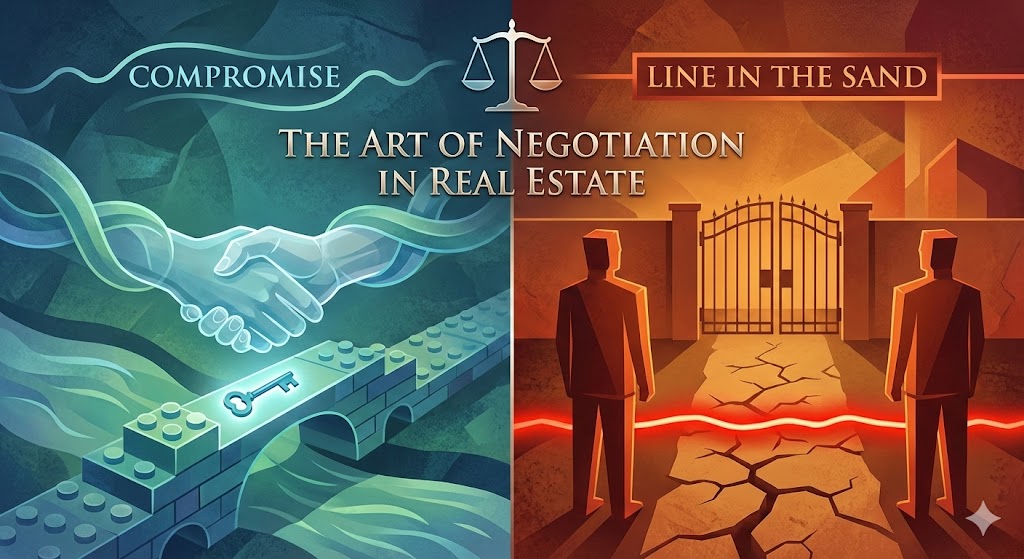
The Art of Negotiation: Compromise or Line in the Sand?
Most people think negotiation means "meeting in the middle." In real estate, that mindset gets sellers
concession-stacked into weak outcomes. High-level negotiation is simpler:
draw your line on what matters—then trade everything else with surgical precision.
12 min read
3 Interactive Tools
Framework: Line in the Sand
Negotiation isn't compromise. It's the disciplined act of protecting your non-negotiables while trading variables to get the deal across the finish line.
Here's what separates amateur negotiators from professionals: amateurs negotiate price. Professionals negotiate outcomes. The difference isn't semantic—it's the difference between walking away with what you expected and walking away wondering what happened.
In real estate, this distinction matters more than in almost any other transaction you'll ever make. Your home is likely your largest asset. The stakes are high. The counterparties—buyers, agents, investors—negotiate deals every day. You might negotiate a home sale once a decade.
That asymmetry creates danger. Not because the other side is malicious (usually), but because they understand something you might not: the headline price is not the outcome. The outcome is what you actually walk away with—your net proceeds—after commissions, credits, repairs, carrying costs, and the cascade of concessions that can accumulate when you don't have a framework.
The mental model: Draw a line on 1–2 non-negotiables (net, deadline, risk tolerance). Then negotiate everything else (close date range, credits, possession, inspection scope) as tradable variables. The line protects the outcome. The variables get the deal done.
Why "Meet in the Middle" Fails in Real Estate
The compromise instinct is deeply human. We're socialized to find middle ground, to be reasonable, to avoid conflict. These are admirable qualities in relationships. In negotiation, they're vulnerabilities.
Here's why: compromise assumes both parties start from equally valid positions and move toward a fair center. But in real estate, the "positions" aren't symmetrical. A buyer's opening offer isn't a genuine assessment of value—it's a strategic anchor designed to shift the midpoint in their favor. When you "meet in the middle" of an artificially low anchor, you've already lost.
1
The Anchor Problem
First offers create psychological anchors. Research in behavioral economics consistently shows that final negotiated prices correlate strongly with initial offers—not with objective value. When you accept the premise that the middle is "fair," you've already ceded ground you didn't need to give.
2
The Multi-Variable Problem
Real estate transactions have dozens of variables: price, closing date, possession, inspections, credits, repairs, contingencies, financing terms, personal property, rent-backs. When you negotiate on "price" alone, you're playing checkers while the other side plays chess. Every variable you ignore becomes a tool they can use against you.
3
The Sequential Concession Problem
Compromise rarely happens all at once. It happens in stages: a price reduction here, a repair credit there, an extended inspection period, a delayed closing. Each feels reasonable in isolation. Together, they compound into catastrophic erosion of value. This is the concession stack—and it's how sellers lose thousands without ever agreeing to a "bad deal."
The Concession Stack: Death by a Thousand Cuts
Let's make this concrete. Imagine you're selling a home with a market value of $400,000. You list at $419,900 to leave room for negotiation. An offer comes in at $390,000. You counter at $405,000. They come back at $395,000. You settle at $400,000. So far, so good—you got your target price.
Then the inspection happens.
The buyer's inspector finds a 15-year-old HVAC system, some minor foundation settling, and a few electrical outlets that aren't GFCI-compliant. None of this is surprising—it's a 15-year-old house. But now comes the repair request: $12,000 in credits.
You negotiate. You settle on $7,500 in credits. That's reasonable, right? The inspection is done. The appraisal comes in at $398,000—$2,000 below the contract price. The buyer asks you to split the difference. You agree to another $1,000 reduction.
Then the buyer's loan takes an extra two weeks to close. Your mortgage payment is $2,400/month. You eat a half-month of carrying costs: $1,200. Plus, you had to cancel your movers and rebook: $400. And you missed the closing date on the home you were buying, so you're in temporary housing: $2,100.
You "got your price" but walked away with $12,200 less than you expected. That's a 3% haircut that never appeared on any single document.
This is the concession stack. It's not dramatic. It's not adversarial. It's just... accumulation. Each concession felt reasonable. Each was negotiated in good faith. But the total outcome was a seller who left $12,000 on the table without ever realizing it.
The Psychology of the Stack
The concession stack works because of three psychological principles:
Sunk cost fallacy: Once you're deep into a transaction, you've invested time, emotion, and money. Walking away feels like losing that investment. So you agree to "one more thing" to protect what you've already put in.
Isolation bias: Each concession is evaluated independently. A $7,500 repair credit feels like a negotiation win when the ask was $12,000. But you're not comparing it to zero—you're comparing it to an artificially inflated anchor.
Certainty premium: As you get closer to closing, the value of certainty increases. You start accepting worse terms just to "get this done." The buyer knows this. Their leverage increases as your patience decreases.
Interactive: Concession Stack Calculator
See how small concessions compound into major net erosion. Enter your scenario to calculate the real cost.
Concession Stack SimulatorWatch the small stuff add up
Net erosion: 0%
0 days1560 days
Your Real Numbers
Headline Price
$400,000
Actual Net Proceeds
$371,300
Total Erosion
-$28,700
Erosion Breakdown
The Line in the Sand Framework
The antidote to concession stacking isn't stubbornness—it's structure. The "Line in the Sand" framework gives you that structure. It works because it separates the negotiation into two distinct categories: things you will not move on, and things you will.
Step 1: Define Your Line (Non-Negotiables)
Before you entertain any offer, before you counter, before you even list—you need to know your line. This isn't about being difficult. It's about being clear. Your line should be one of three things:
Net Proceeds
"I need to walk away with $X after everything." This is the most common line—and often the most important. It forces you to evaluate every concession against a single benchmark.
Hard Deadline
"I must close by X date." When you have an external constraint—a job relocation, a contingent purchase, a life event—the date becomes your line. Everything else bends around it.
Risk Cap
"I cannot tolerate uncertainty beyond X." This might mean: no financing contingencies, capped inspection scope, or proof of funds before you accept. When certainty is the priority, risk becomes the line.
Critical principle: Pick one line. Maybe two. Never three. The more lines you draw, the less meaningful each becomes. If everything is non-negotiable, nothing is—you're just being difficult.
Step 2: Identify Your Variables (Tradables)
Everything that isn't your line is a variable. Variables are your negotiating currency. They're what you trade to protect your line. Common tradables include:
Close date range: Can you close in 21 days or 45? Flexibility here can be worth thousands in other areas.
Possession timing: Rent-backs, early possession, or flexible move-out dates are often more valuable to buyers than price reductions.
Credits vs. repairs: Offering a credit instead of doing repairs can be mutually beneficial—you avoid contractor hassles, they get flexibility.
Personal property: Appliances, furniture, window treatments—these can be bargaining chips that cost you little but mean much to the buyer.
Inspection scope: Pre-inspections, limited inspection windows, or "as-is" clauses can all be traded for better terms elsewhere.
Contingency timelines: Shorter contingency periods reduce your risk and can be traded for other concessions.
The trade principle: Never give something without getting something. Every concession should be part of a trade. "I can do the credit if we tighten the close date." "I'll include the appliances if we remove the inspection contingency." This isn't being difficult—it's being professional.
Step 3: Enforce the Line
Here's where most sellers fail. They define the line, they know their variables, and then—when pressure comes—they move the line. Don't.
Enforcing your line means being willing to say no. It means being willing to walk away. It means accepting that a deal that crosses your line isn't a deal worth taking, regardless of how much time and energy you've invested.
This isn't bravado. It's math. If your line is $380,000 net and a deal would net you $372,000, that deal costs you $8,000. The question isn't "should I take this deal?"—it's "is the certainty of this deal worth $8,000 more than the probability of a better deal?" Sometimes the answer is yes. But you should make that calculation explicitly, not slide into it through accumulated concessions.
Interactive: Build Your Line in the Sand
Define your non-negotiables, set your tradables, and get a recommended lane (Cash, List, or Partner).
Line in the Sand BuilderProtect the line. Trade the variables. Avoid the stack.
Choosing Your Lane: The Highest Form of Negotiation
Here's a truth that most real estate content won't tell you: the best negotiators don't negotiate harder—they negotiate smarter. And the smartest move is often choosing a different lane entirely.
There are three primary lanes for selling a home. Each optimizes for different outcomes. The "right" lane depends on your line.
💵 Cash Sale
Maximum certainty, minimum hassle. Accept a discount for speed and guaranteed closing. Best when your line is deadline or risk-cap.
🏠 Retail Listing
Maximum headline price potential. Accept uncertainty, carrying costs, and concession risk. Best when you have time and a retail-ready home.
🤝 Partner Program
The hybrid. Shrink the cash discount while keeping process controlled. Best when you have equity but the home needs work or your situation has complexity.
The Lane Comparison Matrix
Factor
Cash Sale
Retail Listing
Partner Program
Certainty of Close
★★★★★
★★★☆☆
★★★★☆
Net Proceeds Potential
★★★☆☆
★★★★★
★★★★☆
Time to Close
7-14 days
45-90+ days
30-60 days
Concession Risk
None
High
Controlled
Prep Work Required
None
Significant
Minimal
Showings Required
None
Many
Limited
Best For
Speed, certainty, distress
Retail-ready, patient sellers
Equity + complexity
The Scripts: What to Say When Pressure Comes
Knowing your framework is one thing. Executing it under pressure is another. Here are the scripts that protect your line while keeping the deal moving forward.
When Your Line is Net Proceeds
"I'm flexible on terms if we lock the net."
"If we do a credit, the price needs to stay firm."
"I can consider repairs if we extend the closing date and add the cost to price."
"What would you need on terms to make the current price work?"
When Your Line is Deadline
"The close date is the line. Everything else is tradable."
"If we hit the date, I can be flexible on possession."
"I can consider a credit if we shorten the inspection period."
"What needs to happen for you to close by [date]?"
When Your Line is Risk Cap
"I need certainty. Show me you can close."
"I'll need proof of funds before we proceed."
"I can consider your offer if we cap inspection credits at $X."
"What contingencies can we eliminate to strengthen this?"
When They Push After You've Conceded
"We've already moved. Now you need to meet us."
"We've made significant concessions. This is where we are."
"I've moved on X. For me to move again, I need something in return."
"Let's package this: what's the final ask that gets us both to close?"
The meta-script: Every conversation should end with clarity on where things stand and what happens next. "So we're agreed on X, we're still working through Y, and next step is Z by [date]. Correct?" This prevents scope creep and keeps momentum.
The Psychology Behind the Framework
Understanding why the Line in the Sand framework works makes it easier to execute. The framework leverages several psychological principles that work in your favor:
1. Clarity Creates Confidence
When you know your line, you negotiate from a position of psychological strength. You're not reacting to offers—you're evaluating them against a clear benchmark. This confidence is perceptible. It changes the dynamic. Counterparties who sense uncertainty will probe for weaknesses. Counterparties who sense clarity will respect boundaries.
2. Scarcity of Concessions
When you frame certain things as tradable and others as non-negotiable, you create artificial scarcity. The things you're willing to trade become more valuable because they're the only things available. This is basic economics applied to negotiation: constrain supply, increase perceived value.
3. Reciprocity Obligation
When you make a concession, human psychology creates pressure for the other party to reciprocate. But this only works if you frame the concession explicitly. "I'm moving on the close date to meet your timeline—what can you do on the credit?" activates reciprocity. Silently accepting a change does not.
4. Loss Aversion
People feel losses more acutely than equivalent gains. When you establish your line early and clearly, any attempt to cross it feels like taking something away—not just failing to get something extra. This asymmetry works in your favor. The buyer has to weigh the psychological cost of "taking" your line against the benefit of the concession.
5. The Power of Walking Away
The ultimate leverage in any negotiation is the willingness to walk away. This isn't a bluff—it's a boundary. When the other party believes you'll actually terminate the negotiation if your line is crossed, they calibrate their behavior accordingly. The Line in the Sand framework makes walking away easier because it's not emotional—it's logical. The deal either works within your parameters or it doesn't.
Case Studies: The Framework in Action
Case 1: The Relocation Deadline
Situation: Seller needed to close by March 15 for a job relocation. Home needed cosmetic updates. Initial offer was 8% below ask with 45-day close.
Outcome: Closed March 12. Seller avoided $4,200 in carrying costs and $6,000 in temporary housing. Net proceeds exceeded original target despite lower headline price.
Case 2: The Net Proceeds Floor
Situation: Seller had specific payoff requirements (mortgage + HELOC + moving costs). Home was in good condition but dated.
Line: $340,000 net proceeds minimum
Variables traded: Flexible on close date (21-60 days), willing to leave window treatments and garage storage, offered to pay for home warranty
Outcome: After inspection, buyer requested $12,000 in credits. Seller countered with $6,000 credit + $3,000 price increase + home warranty ($500). Final net: $341,200.
Case 3: The Risk Cap
Situation: Inherited property with deferred maintenance. Seller lived out of state and couldn't manage repairs or extended timelines.
Line: As-is sale with capped inspection contingency ($5,000 max credit)
Outcome: Closed in 18 days with zero re-trade. Buyer knew the terms upfront, priced accordingly, and both parties avoided months of back-and-forth.
Frequently Asked Questions
Is this approach too aggressive? Won't it scare off buyers?
The Line in the Sand framework isn't aggressive—it's clear. Buyers (and their agents) actually appreciate clarity. Ambiguity creates friction; boundaries create efficiency. The sellers who struggle are those who seem uncertain, who keep moving, who signal that everything is negotiable. Clear framework = faster close.
What if I have multiple priorities? Can I have more than one line?
You can have a primary line and a secondary line, but be careful. Each additional constraint reduces your flexibility and narrows the universe of acceptable deals. If you must have two lines, make them complementary (e.g., "net + deadline" where you'd take less net for a faster close). Never have three lines—at that point, you're not negotiating, you're dictating.
How do I know what my line should be?
Work backward from your actual needs. What do you need the proceeds for? What's the consequence of missing a deadline? How much uncertainty can your life absorb right now? Your line isn't what you want—it's what you need. Wants are tradable. Needs are the line.
What if the market is bad and I can't hold my line?
If no deal can meet your line, you have two options: (1) don't sell now, or (2) redefine your line based on new reality. Both are valid. What's not valid is holding a line, letting it erode through concessions, and ending up with neither the line nor a good deal. Be clear-eyed about market conditions, set a realistic line, and hold it.
When should I choose the Bee's Knees Partner Program vs. cash vs. listing?
Cash when speed/certainty is the line and you're willing to pay for it via discount. Listing when you have a retail-ready home, patience, and high risk tolerance. Partner Program when you have equity, the home needs work or your situation has complexity, and you want to capture more value than cash while avoiding listing chaos. The interactive tool above can help you assess.
What's the difference between price and net proceeds?
Price is the number on the contract. Net proceeds is what you deposit in your bank account after commissions, credits, repairs, closing costs, prorations, and concessions. Professional negotiators focus exclusively on net. Amateur negotiators celebrate price while net erodes underneath them.
Your Next Move
Negotiation isn't a talent—it's a skill. And skills can be systematized. The Line in the Sand framework gives you that system: define your non-negotiable, identify your tradables, bundle concessions into trades, and hold the line.
The best negotiators don't argue inside a bad lane—they pick a better lane. Whether that's cash, listing, or partnership, the right lane is the one that protects your line while maximizing your net.
Local Home Buyers USA is a seller-solution marketplace. We may buy directly, partner with local buyers, or help you compare paths. This article is educational and not legal or financial advice. Net proceeds vary by property, market, and title conditions.