
PropTechUSA.ai Research • Incident Analysis
Cloudflare Claims a “Bot Bug” Took Down the Internet. We’re Not So Sure.
On November 18, 2025, a Cloudflare outage briefly broke huge pieces of the internet — including funnels that matter to home sellers and real estate investors. Cloudflare calls it a “bot bug.” Our telemetry suggests the story — and the risk — is more complicated.
TL;DR — Why This Outage Matters for Housing
- Cloudflare’s official story: a latent bug in a bot/threat configuration file grew it past limits and crashed key services.
- Our telemetry: a structured traffic spike — skewed to specific IP regions — during the same critical window.
- We’re not alleging a cover-up, but raising questions about how “bug vs. attack” is framed for shared infrastructure.
- For sellers and operators, outages like this are not abstract tech news — they directly hit lead flow, timing, and net proceeds.
See how we price infrastructure risk into real offers: Unified PropTechUSA.ai Net Offer Sheet →
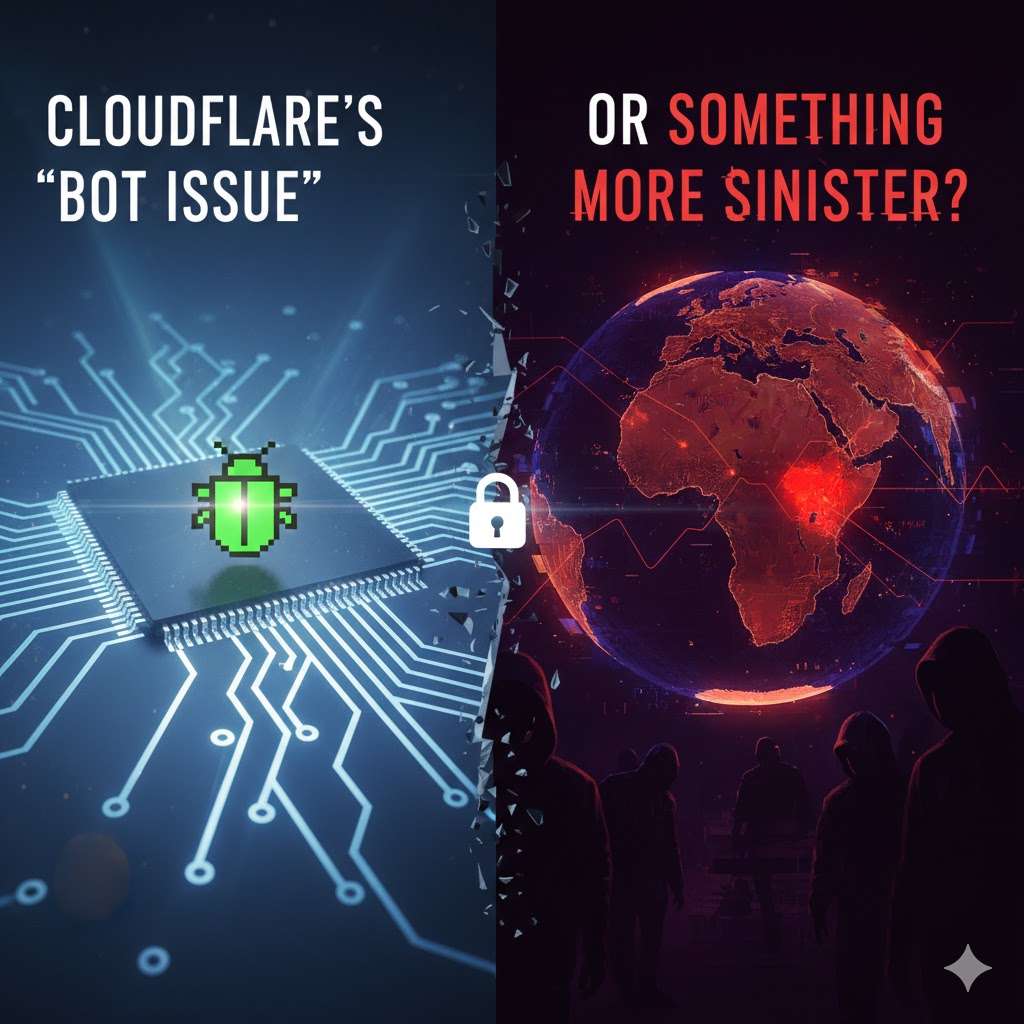
If you tried to access X (Twitter), ChatGPT, Spotify, or any of thousands of other sites around 11:20 UTC on November 18, 2025, you probably hit a 5xx error and wondered if the internet had simply broken.
It wasn’t “the internet” in the abstract. It was Cloudflare — a critical layer that sits in front of a huge chunk of the modern web and part of the infrastructure stack behind Local Home Buyers USA and PropTechUSA.ai.
Within hours, Cloudflare published their explanation: a latent bug in an automatically generated configuration file used for bot and threat traffic management. The file grew beyond its expected size, tripped a hard limit, and caused traffic-handling software to crash. Official statements emphasize one key line: there is no evidence of an attack or malicious activity.
From a pure PR standpoint, that’s the most comforting story you can tell. From a risk and data standpoint, our telemetry suggests there’s more that needs to be discussed in public.
Important note: Nothing in this article alleges fraud or intentional cover-up by Cloudflare. We are sharing our own observations, logs, and interpretations and raising questions that matter to anyone whose business depends on Cloudflare, especially proptech operators, home sellers, and real estate investors.
What Cloudflare Says Happened
Based on Cloudflare’s public statements and same-day reporting, the official story follows a clear chain:
- A configuration file used for threat and bot traffic management was automatically generated as usual.
- Due to a latent software bug and a routine internal change, the file grew far larger than expected.
- The oversized file triggered a crash in the software system that handles traffic for multiple Cloudflare services.
- The result: widespread 5xx errors and timeouts across major sites and APIs — including some of our own systems.
- Cloudflare and multiple news outlets emphasize there is no evidence of a cyberattack driving the incident.
In other words: a highly embarrassing but ultimately “boring” software and configuration failure at one of the most sophisticated security companies on earth.
And to be fair, “boring” failures are extremely common in complex distributed systems. We see that every day in our own industry when small CRM sync issues cascade into missed follow-ups and lost offers.
What We Saw on Our Side of the Glass
While Cloudflare was fighting fire at the core, we were watching the smoke from the edge. Our infrastructure — the same stack that powers PropTechUSA.ai’s Unified Net Offer Sheet and our nationwide seller funnels — saw something we couldn’t ignore.
Inside our logs for the window around 11:15–11:30 UTC, we observed:
- A sharp, concentrated spike in inbound requests hitting monitored endpoints that normally show a smooth, predictable pattern.
- The spike was significantly skewed toward IP space geolocated to Nigeria according to our internal geo-IP tools.
- The traffic pattern looked structured rather than random: bursts that resemble a testing or probing pattern more than organic user behavior.
Could this be coincidence? Absolutely. Geolocation is imperfect, routing during global incidents can be noisy, and correlation does not automatically equal causation.
But timing matters. The surge we saw lines up closely with the window when Cloudflare’s bot-related configuration file was allegedly expanding and crashing components. When you’re in the risk business, you don’t ignore that kind of overlap — you dig deeper.
Again: we are not claiming this traffic caused Cloudflare’s outage, nor that Cloudflare is wrong in stating that they found no evidence of an attack in their own environment. We are saying our independent data shows a traffic pattern that deserves to be part of the conversation.
Bug, Attack, or Both? Why the Framing Matters
In complex systems, failures rarely have a single neat cause. What looks like a “bug” inside the perimeter can be heavily influenced by what’s happening just outside it.
Here are three broad scenarios that fit the facts as we currently understand them:
-
Pure internal bug
Cloudflare’s official version is 100% correct. An internal change caused a configuration file to balloon unexpectedly, trip a hard limit, and crash critical software. The traffic we saw is pure coincidence. -
Design weakness stress-tested by external traffic
A latent bug existed, but it only manifests when the system is under certain stress patterns. Malicious or experimental traffic from the outside world — potentially from specific regional IP space — provided the exact “stress test” needed to break the system. -
Multi-causal incident with simplified messaging
The root cause analysis internally may well describe several contributors, including traffic anomalies. But public messaging focuses on the simplest, least alarming story: “bug, not breach.”
From a regulatory standpoint, the difference between “bug” and “attack” is enormous. From the perspective of a seller, investor, or operator whose portfolio depends on always-on digital funnels, the difference is academic. Either way, the lesson is the same: single points of failure in shared infrastructure can hit your deal flow like a hurricane.
What a Cloudflare Outage Has to Do with Home Sellers and Real Estate Investors
At first glance, a global Cloudflare outage sounds like a pure “tech story.” It’s not. For us, this was a live-fire test of our proptech risk model.
Local Home Buyers USA and PropTechUSA.ai operate as a nationwide, data-driven acquisitions engine. Our pipelines are built to measure and respond to signals like:
- Search impressions and click-through rates
- Multi-channel lead arrival patterns (Google Ads, organic, social, referral, etc.)
- Seller response timing and negotiation windows
- Portfolio-level offer spreads and net proceeds
When Cloudflare goes dark, all of that gets stress-tested at once:
- Leads stall: motivated sellers can’t reach you, then call the next postcard or website on their list.
- Negotiations slip: a seller ready to sign tonight can’t access a portal or e-sign link, and suddenly you’re renegotiating on Monday morning instead of locking in Sunday night psychology.
- Data gaps appear: your models that forecast home sale sentiment and negotiation risk lose clean data for hours.
This is exactly why we built models like our HSS API 2026 U.S. Home Sale Sentiment Prediction and our analysis of the Sunday Night Spike & Monday Home Sale Negotiation Risk . Macro outages like Cloudflare’s incident don’t just break websites; they distort seller psychology and timing.
Outage-to-Offer Impact Lab: How Fragile Is Your Funnel?
This is a simplified sketch, not a prediction from Cloudflare or a full risk model. It’s how we think about outages when we price, staff, and structure deals. Check the boxes that describe your current setup and watch how your risk shape changes.
Step 1 · Describe Your Infrastructure & Deal Flow
These toggles are about you, not Cloudflare. We’re not alleging an attack; we’re mapping how shared infrastructure outages flow through to real offers.
Step 2 · See Your Outage Impact Shape
In this setup, you’re exposed but not helpless. A Cloudflare-style outage would sting — especially on peak negotiation nights — but multi-channel scripts and a basic playbook keep most deals recoverable.
Want to see how we internalize this in real math? Start with the Unified Net Offer Sheet and the Partnership Value Index (PVI).
From Outages to Offers: Building a More Resilient Deal Engine
If you’re a homeowner, none of this jargon matters unless it affects your net offer, your timeline, and your stress level. If you’re an operator or investor, it matters because this is where you either pick up market share — or lose it.
We’ve structured our offer and partnership frameworks to assume exactly this kind of infrastructure risk. Two key tools from our research lab:
-
Unified Net Offer Sheet
Our Unified PropTechUSA.ai Net Offer Sheet is designed to show sellers, in plain language, how different exit paths stack up: direct cash offers, novation partnerships, who-pays-what closing costs, and timeline risk. When infrastructure wobbles, this sheet helps keep the decision grounded in math, not panic. -
Partnership Value Index (PVI)
Our Partnership Value Index (PVI): Novation vs. Cash quantifies the value split between seller and investor across structures. In outage scenarios, where communication delays and rescheduling can erase margin, PVI helps us decide whether to stay aggressive, pivot structures, or step back.
When critical infrastructure like Cloudflare stumbles, we don’t just shrug and tweet “the internet is down.” We rerun the numbers on:
- How many sellers couldn’t reach us during the outage window
- How many live negotiations fell into a higher-risk time band
- How much partnership value needs to be shared or shifted to keep deals fair in the face of added friction
Questions Cloudflare Still Needs to Answer
Against that backdrop, our interest in Cloudflare’s outage isn’t theoretical. It’s practical and financial.
Given what we observed, there are a few questions we believe Cloudflare — or any provider in this position — should answer more explicitly as the post-mortem matures:
-
How deeply did you investigate regional and ASN-level anomalies?
When you state “no evidence of an attack,” does that include a full analysis of traffic spikes from specific regions, including those that match spikes independent observers have logged? -
How will you protect against configuration files becoming hidden kill switches?
What guardrails now exist so that an automatically generated bot or threat feature file can’t exceed a safe threshold without being quarantined and rejected? -
How will future communications handle multi-causal incidents?
If a future event is both a bad internal change and clearly stress-tested by hostile traffic, will public messaging acknowledge both? Or will “no evidence of malicious activity” remain the default headline?
For the record, we want Cloudflare to win. The entire ecosystem does. Our business, and the sellers we serve, rely on them. But precisely because they’re so central, their explanations need to be more than just technically correct. They need to be risk-complete.
What Homeowners and Partners Can Do Next
You don’t control Cloudflare. You do control who you partner with and how your deals are structured.
At Local Home Buyers USA — powered by the research engine of PropTechUSA.ai — we’re doing three things in the wake of this outage:
-
Reinforcing multi-path communication
We assume that at any given moment, one communication channel might fail. That’s why our offer workflow can move over phone, SMS, email, and backup contract links — not just one brittle web session. -
Stress-testing our models against outage scenarios
We’re feeding this event back into our home sale sentiment and timeline models and our Sunday Night vs. Monday negotiation framework to better predict where deals are at risk when infrastructure blinks. -
Keeping offer math transparent even when systems wobble
Our Unified Net Offer Sheet and Partnership Value Index (PVI) are built so that you can see exactly how infrastructure risk, delays, and friction are priced into your deal — and what we’re doing to absorb as much of that friction as possible on our side.
If you’re a homeowner sitting on a problem property, or an investor/operator who wants a partner that actually treats infrastructure as a first-class risk, not an afterthought, this outage is a dress rehearsal for the next five years of the digital housing market.
Final Thought: Outages Are Inevitable. Ignoring Them Is Optional.
Cloudflare’s November 18 outage won’t be the last time a single configuration file or internal tool knocks out a big slice of the internet. Whether you accept their explanation at face value or share our questions about the full story, one thing is obvious: your real estate business can’t afford to treat this as purely “someone else’s problem.”
At Local Home Buyers USA, our job is to translate events like this into concrete protections for you: clearer offer math, more resilient communication paths, and smarter timing around negotiations and closings.
If you want to see how that looks in practice, start by reviewing our Unified PropTechUSA.ai Net Offer Sheet or explore the Partnership Value Index (PVI) for novation vs. cash . Then, when the next “bot bug” hits, you’ll know your deal strategy hasn’t been left to chance.
FAQs: Cloudflare Outages, “Bot Bugs,” and Real Estate Risk
Did a Cloudflare bug cause the November 18, 2025 outage?
According to Cloudflare’s public incident notes, a latent bug in an automatically generated configuration file used for bot and threat management caused the file to grow beyond its intended size and crash key services. Our article doesn’t dispute that explanation; it adds independent telemetry and risk questions on top of it.
Was the outage a cyberattack?
Cloudflare has stated that they found no evidence of a cyberattack in their own environment. Separately, our systems observed a structured traffic spike from specific IP regions during the same window. That doesn’t prove an attack caused the outage — it simply means there are external patterns worth analyzing alongside the internal bug narrative.
Why should home sellers and investors care about a Cloudflare outage?
Because outages like this interrupt lead flow, delay signatures, and distort seller timing. If motivated sellers can’t reach you during a critical decision window, that can change who gets the deal, when it closes, and at what net. Treating shared infrastructure as a real risk input — not background noise — is part of modern deal engineering.
What does Local Home Buyers USA do differently in response?
We build multi-path communication (web, phone, SMS, email), feed outage windows into our sentiment and timing models, and use tools like the Unified Net Offer Sheet and PVI to keep offer math transparent even when systems wobble. The goal is simple: make sure sellers and partners aren’t the ones absorbing most of the friction when infrastructure fails.