Skip to content
Net-Proceeds Olympics Cash Offer vs Partnership Novation vs Listing
Dark

The Net-Proceeds Olympics: Cash Offer vs Partnership Novation vs Listing (Who Actually Wins?)

Most sellers don’t lose money on the price. They lose it in the messy middle: repairs, delays, showings, inspection leverage, last-minute concessions, and the late-game renegotiation that quietly steals upside. This page turns the decision into a visual scoreboard—then recommends the lane that maximizes what you keep.

CERTAINTY SPREAD CONCESSION STACK RETRADE RISK FRICTION TAX NET-FIRST MATH CERTAINTY SPREAD CONCESSION STACK RETRADE RISK FRICTION TAX NET-FIRST MATH

What this is

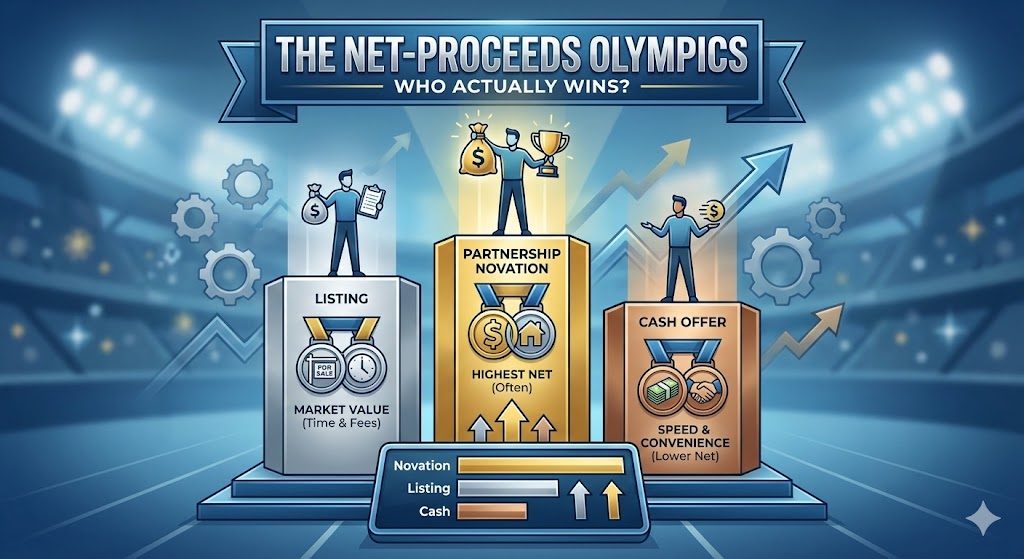
A fast, visual way to compare three selling lanes: Cash Offer (speed + certainty), Partnership Novation (often higher net with controlled chaos), and Listing (highest ceiling, highest friction).

Research version: Certainty Spread Report 2026

What matters most

Your outcome is rarely about “cash vs list.” It’s about how much friction you can tolerate before the process forces a discount.

Deep dive: Closing Friction Tax

Net-Proceeds Olympics podium comparing listing, partnership novation, and cash offer
The only scoreboard that matters: net proceeds + certainty + time.

Live Scoreboard (updates as you interact)

You’ll see points accumulate across the lanes. Higher points = better fit. The “Friction Tax” rises when repairs, timeline, showings, or uncertainty get expensive.

Cash Offer Speed & Certainty

12

Best when time, condition, privacy, or late-stage renegotiation risk makes “top dollar” a trap.

Partnership Novation Net + Control

16

Often the best blend: retail upside without you becoming the project manager.

Listing Highest Ceiling

10

Best when the home is turnkey and you can tolerate the showing/inspection/concession cycle.

Friction Tax
22% (lower is better)

Serious reads: Retrade Economy · Concession Stack · Cash Offers (Glass Box)

The Events (where sellers win or lose net proceeds)

Think of this like a financial triathlon. The winner isn’t always the highest offer. The winner is the lane that produces the highest expected net proceeds after repairs, concessions, delays, and renegotiation risk.

Event #1: Speed Sprint (timeline certainty) · Event #2: Repair Decathlon (inspection leverage) · Event #3: Concession Stack (credits/fees) · Event #4: Retrade Trap (late renegotiation) · Event #5: Certainty Spread (expected value vs best-case).

The Deductions (the last 4% that decides who actually wins)

This is where sellers underestimate the math. The “final 4%” isn’t one line item—it’s a stack of small deductions that shows up late. On small screens, the table scrolls (hint included).

Swipe →
Category Cash Offer Partnership Novation Listing
Net proceeds Lower ceiling, high certainty. Often higher net with managed execution. Highest ceiling, highest variability.
Repairs Usually none (as-is). Often coordinated strategically to retail. Often required + negotiated again at inspection.
Concessions Typically fewer leverage moments. Controlled by plan + process. Can stack: credits, repairs, price cuts.
Retrade risk Lower (cleaner close). Moderate (managed). Higher (inspection/appraisal leverage).
Time & stress Low. Low-to-moderate (partner carries load). High (showings, negotiations, uncertainty).
Educational only. For the research lens behind this table: Closing Friction Tax.

Net-Proceeds Mini Simulator (cash vs novation vs listing)

This is a high-level net proceeds calculator to help you visualize the tradeoffs. Adjust the inputs and watch the lanes update. (Designed to highlight when partnership novation is the best blend of net + control.)

Tip: If your repairs are heavy, watch how fast friction climbs and how “certainty spread” expands.

Estimated net proceeds

Cash offer lane $0
Fast close, minimal concessions. (Still includes estimated closing costs.)
Partnership novation lane $0
Often the sweet spot: retail upside with a managed process and defined economics.
Listing lane $0
Highest ceiling, but your net depends on concessions, time, and inspection leverage.

Want us to run your real numbers (in writing)?

We’ll compare cash, partnership novation, and a listing-style net sheet so you can choose the lane with clarity.

Related: Seller Risk Gap

60-Second Fit Quiz (designed to surface when novation is best)

Answer five questions. We’ll update the scoreboard and recommend the lane that fits your timeline, condition, and risk tolerance.

Net-Proceeds Fit Quiz

Question 1 of 5

Loading…

Your lane:

🏅 Certainty High
🏅 Net Proceeds High
🏅 Convenience High

Next step (simple)

Get your options in writing—cash, partnership novation, and listing-style net comparison.

FAQ

What is a partnership novation in real estate?

A partnership novation is a strategy where you work with a partner to sell your home to a retail buyer, while the partner manages the process and you aim to capture more net proceeds than a typical as-is sale.

Is a cash offer always worse than listing?

Not always. A cash offer can win when repairs, timeline, privacy, or deal-fall-through risk makes the “highest list price” unlikely to become the highest net proceeds.

When does listing usually win?

Listing usually wins when the home is turnkey, you have time for showings and negotiations, and your market supports strong buyer financing with minimal concessions.

What is the “certainty spread”?

The certainty spread is the gap between a theoretical best-case outcome and the amount you can confidently expect after friction, concessions, delays, and renegotiations are considered.

What is a “retrade”?

A retrade is a late renegotiation where a buyer asks to reduce the price after inspections or delays, often when the seller has already invested time and feels locked in.

Can Local Home Buyers USA show all three options?

Yes. We can compare a cash offer, a partnership novation pathway, and a listing-style net sheet so you can choose the lane that fits your timeline, condition, and risk tolerance.

More internal research: Concession Stack · Closing Friction Tax