Local Home Buyers USA™Home of the Instant Home Offer™
Clearance Tape
LIQUIDITY time-to-close is a priced assetINSURANCE quotes can gate financingROOF age becomes a “payment shock” triggerTWO LANES retail-financeable vs friction-heavyINSPECTION narrative replaces compsGOVERNANCE HOA/condo docs can delay closing
LOCAL HOME BUYERS USA — powered by the research of PropTechUSA.ai
The End of the “Retail-Ready” Housing Era: Why the Market Split Into Two Lanes (2026 Outlook)
“Retail-ready” used to mean clean, livable, and cosmetically acceptable. Today, that definition is obsolete. A home is retail-ready
only when it clears a modern clearance process—financing, insurance, appraisal, inspection, and closing—without
triggering friction that forces price cuts, concessions, or fall-through.
The market has quietly split into two lanes: Retail-Financeable homes (friction-light and liquid) and
Friction-Heavy homes (where underwriting, insurability, condition, or documentation create an invisible toll).
This report is a field guide to that split—built for mobile, built to hold together, and built to convert confusion into a decision.
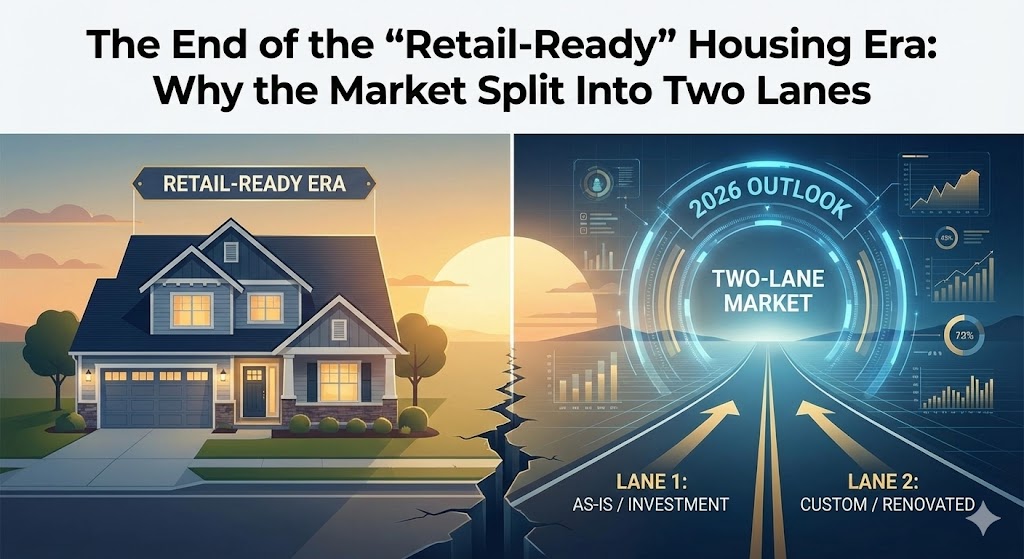
Featured visual: The new “retail-ready” isn’t cosmetic. It’s clearance:
financeable + insurable + documentable—without deal-breaking friction.
A Glass-Box Cash Offer is not “just a cash offer.” It’s a transparent offer where you can see the logic:
repair assumptions, holding costs, resale risk, timeline, and the certainty premium—so you can compare it to retail or hybrid
options with a real decision framework (not guesswork).
See how it works →
Terminal Snapshot • Clearance Regime
STATIC MODULE • swipe →
Market StateTWO-LANE
Financeable vs Friction-Heavy
The new split is clearance-driven: insurability + underwriting tolerance + documentation.
Tip: On mobile, swipe the ribbon like a terminal tape. No scripts required.
Executive summary
The housing market isn’t just repricing homes—it’s repricing risk. That repricing doesn’t show up in listing photos.
It shows up in whether a deal clears the gates that lenders, insurers, and buyers now treat as non-negotiable.
In a two-lane market, the most expensive mistake is misclassification: forcing a friction-heavy home through a friction-light strategy.
When the clearance gates push back, sellers pay the friction tax—longer timelines, stronger retrades, deeper credits, and “almost deals”
that die late.
The new premium isn’t granite. It’s clearance.
Retail-ready now means: financeable + insurable + documentable + negotiable without the deal breaking.
If you want the cleanest “outcome math” framework for choosing between options, the
Partnership Value Index (PVI)
is designed for exactly this moment.
The two lanes
Think of today’s buyer pool as a set of filters, not a single crowd. The first filter is monthly payment. The second is underwriting
tolerance. The third is insurance availability. Past that, inspection narrative and documentation quality decide the leverage.
Retail-Financeable: clears gates with minimal drama → broader buyer pool → faster time-to-close → fewer mandatory concessions.
Friction-Heavy: fails one or more gates → thinner pool → slower cycle → higher fall-through risk → stronger retrades.
Governance: HOA/condo docs, approvals, restrictions, special rules.
You don’t lose deals because a house has issues. You lose deals because the buyer feels exposed.
Reduce perceived exposure and you reduce fall-through and concession gravity.
Animated underwriting radar (visual only)
This is the only motion module. It loops smoothly and is tuned so it won’t “fight” the copy.
If you prefer a static page, switch Motion: OFF up top.
Each “ping” is an underwriting question: roof, water, electrical, insurance, documentation.
Clear those and you’re in the retail lane. Ignore them and you’re routed into the friction lane—even if your photos look great.
Lane selector (safe mini-tool)
This tool is intentionally simple so it won’t break. It gives a directional lane signal you can compare against quotes and documents.
Comps don’t know your insurance quote, roof band, or title story. Price without clearance is theory. Clearance first, pricing second.
2) Control the narrative before inspection writes it
Buyers retrade hardest when they feel surprised. Quotes, invoices, and documentation turn unknowns into line items.
3) Pick the lane that matches your property and your time risk
Retail listing can maximize price when clearance is strong. Hybrid strategies (novation logic) can convert friction into upside when
the spread justifies it. Certainty paths can dominate when time risk is the enemy.
Use Ways to Sell to compare strategies and
PVI to quantify the trade.
In this market, certainty is leverage.
It’s not about “selling cheap.” It’s about selling intelligently under risk-pricing reality.
FAQ
Is “retail-ready” dead for every house?
No. It’s dead as a visual definition. Retail-ready still exists, but it means clearance, not cosmetics.
What’s the fastest way to know my lane?
Start with insurance quote reality, roof band, and documentation friction. Then compare outcomes:
Glass-Box Cash Offer +
PVI.
Disclosure: This is educational content, not legal/financial/insurance advice. Confirm with qualified pros in your area.
Need certainty?
Compare paths or request a transparent offer.