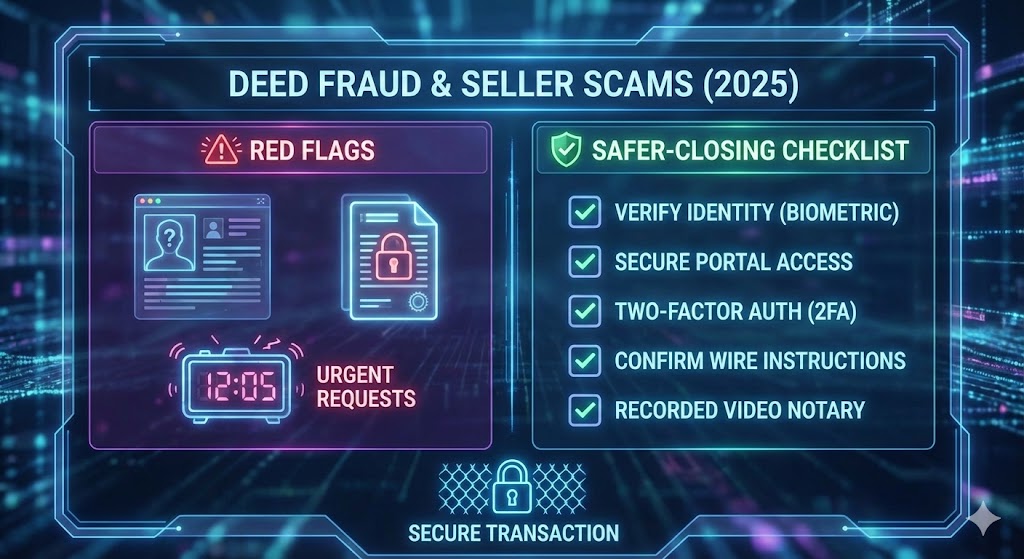
What Is Deed Fraud (Title Theft) & How It Shows Up in 2025
Deed fraud is the unauthorized transfer or encumbrance of your home. Criminals use forged signatures, counterfeit notary seals, synthetic identities, and social-engineering tactics to slip past busy teams. It often pairs with seller impersonation: a scammer lists a property they don’t own—usually a vacant residence, rental, or second home—and pushes for a lightning-fast close before anyone looks closely.
Common Tactics (Know the Patterns)
- Seller impersonation: Fraudster pretends to be the owner, uses a burner number, and refuses live video ID checks.
- Forged deeds/quitclaims: A bogus deed is recorded, then the crook flips or borrows against the property.
- RON abuse: Remote Online Notarization done with synthetic IDs or deepfake liveness attempts.
- Wire diversion: Spoofed email/wire instructions redirect closing funds to mule accounts.
Why It’s So Costly for Sellers
- Legal unwind: Quiet title actions, lis pendens, and attorney fees add stress and delay.
- Timeline risk: Your move, purchase, or payoff can implode when funds go missing.
- Identity fallout: If IDs are compromised, credit and banking disruptions can linger.
Good to know: Many title insurers now offer enhanced owner’s coverage or post-policy forgery endorsements. Ask what’s available in your state.
Bottom line: you can still sell your house fast and keep your closing secure. The key is to run a tight, modern playbook that verifies identities, locks down wires, and documents chain-of-title clearly.
Who Gets Targeted—And Why Cash Home Sales Need Strong Controls
Scammers hunt for as-is, quick-close scenarios where people are moving fast and skipping steps. That’s why “sell my house fast” and “cash home buyers” spaces must run elevated safeguards. The most common targets include:
High-Risk Property Situations
- Vacant homes & second homes: No neighbors to notice unusual activity.
- Out-of-state owners: Harder to verify in person; easy to impersonate.
- Rentals: Tenants limit access; scammers hide behind “no interior showings.”
- Estates/probate: Multiple heirs, unclear authority, and loose paperwork.
Human Factors Scammers Exploit
- Urgency bias: “We must close tomorrow” pressure tactics.
- Authority bias: Fake “attorneys” and “bank officers” who email instructions.
- Tech fatigue: People skim emails and miss domain look-alikes.
- Shame/silence: Victims delay reporting because they feel embarrassed.
Pro tip: The moment two or more red flags appear together, pause and re-verify identities and wires via known, independently sourced phone numbers.
The 15 Biggest Red Flags Sellers Shouldn’t Ignore
- “We must close tomorrow.” Artificial urgency is scam oxygen.
- Refusal to pass live video ID checks. They prefer SMS or email only.
- Inconsistent ID details. Names, addresses, or signatures don’t match prior records.
- No interior access. “I’m overseas—just sign.”
- Last-minute power of attorney with off-register notary details.
- Cashier’s-check overpayments and refund requests.
- Look-alike domains sending wire instructions (e.g., titleco.co vs titleco.com).
- New payoff or HOA contacts that don’t match verified sites or numbers.
- County recorder alert pings for filings you didn’t initiate.
- No proof of earnest money or source of funds.
- Rushed mobile notary with mismatched seal/commission info.
- Buyer avoids licensed title/escrow or refuses secure portals.
- Fresh, unexplained liens in the title update.
- Remote “owner” can’t pass KBA (knowledge-based authentication).
- “Free monitoring” emails that phish for your SSN, deed, or parcel data.
Action: When you see red flags, demand a video ID verification, independent wire call-backs, and a title re-check before proceeding.
The Safer-Closing Checklist (Use This With Your Agent & Title Company)
Identity & Ownership
- Require live, multi-factor ID verification for all signers (government ID + liveness + KBA).
- For RON (Remote Online Notarization), confirm platform audit trails and ID standards.
- For LLC-owned property, verify authority to sign and beneficial ownership.
- Enroll in county property-fraud alerts where available.
Funds & Wires
- Never trust emailed wire instructions. Call a verified, known number to confirm.
- Use passphrases and call-back verification for any changes.
- Confirm payoffs directly with lenders; avoid intermediaries and new “liaisons.”
- Reject overpayments/refund wires and unusual check scenarios.
Title, Escrow & Insurance Controls
| Control | Ask For | Why It Matters |
|---|---|---|
| Licensed title/escrow | Written ID & wire procedures; secure portal with role-based access | Reduces spoofing and unauthorized changes |
| Title search scope | Re-check for new liens/owner changes in last 12 months | Catches late-stage tampering |
| Owner’s policy | Enhanced policy or post-policy forgery endorsements | Potential protection if fraud appears after closing |
Prefer we run this playbook for you?
We buy houses as-is nationwide and coordinate a secure, verified closing with licensed title/escrow partners.
Wire-Fraud Best Practices (Copy & Use)
Wire Call-Back Script
Say this before any wire:
“Hi, I’m verifying outgoing wire instructions for file [#]. Please read back the full account name, number, and routing you have on file. My passphrase is [phrase agreed at open]. If anything differs, halt the wire and call me back at [my verified number].”
Do / Don’t Checklist
- Do confirm wires via known, verified phone numbers only.
- Do set a unique passphrase at file open for call-backs.
- Don’t rely on links inside emails to get phone numbers.
- Don’t approve last-minute bank changes without a call-back and written confirmation in the portal.
Tip: Keep all confirmations in a secure deal room (portal) with immutable logs.
If You Suspect Deed Fraud or Wire Fraud (Step-by-Step)
- Pause the transaction and alert your title officer and agent immediately.
- Contact the county recorder for recorded document copies and recording logs.
- File a police report with detailed timelines and any suspicious communications.
- Notify your bank and the receiving institution to request urgent recall/hold.
- Report cybercrime to the appropriate national portal in your country and keep the complaint number.
- Retain a real estate attorney to pursue deed cancellation/quiet title and, if advised, a lis pendens.
- Ask your title agent about claims if your policy or forgery endorsements may respond.
Speed wins: The faster you alert title, banks, and authorities, the higher the odds of containing funds and reversing damage.
Case Studies, Myths & Reality Checks
Mini Case Study: The Vacant Bungalow
A family inherits a vacant bungalow. A “seller” appears with a convincing ID and insists on a 72-hour close. The title update shows a new quitclaim recorded days earlier—nobody in the family signed it. The agent pauses closing, title escalates for enhanced ID proofing, and the family files a report. Because the deal was paused early, the fraudulent chain stops cold and the rightful owners retain control.
Myth vs Reality
Myth: “Deed fraud only hits luxury homes.”
Reality: Scammers prefer properties with low friction—vacant or out-of-state ownership—regardless of price.
Myth: “If the title says it’s clear, I’m safe.”
Reality: Title is a snapshot; fresh filings can appear. That’s why late-stage re-checks matter.
Myth: “Emailing is fine if it’s from the agent.”
Reality: Accounts get spoofed. Always call a verified number for wires and payoffs.
Takeaway: The combination of identity proofing, secure portals, and independent wire verification neutralizes most of the risk without slowing a fast, as-is sale.
Localize This for Your State & City
We operate nationwide. If you need a secure cash home buyer in your market, we’ll tailor the process to your state’s ID, notary, disclosure, and recording rules. Add local keywords to this section for SEO (e.g., sell my house fast Texas, cash home buyers Florida, sell house as-is California, sell inherited house Georgia, sell house fast Indiana, sell my house fast Minnesota, cash buyers Ohio).
Popular States
City Clusters (Examples)
- Texas: Dallas–Fort Worth, Houston, San Antonio, Austin
- Florida: Tampa Bay, Orlando, Miami–Dade, Jacksonville
- California: Los Angeles, Inland Empire, Sacramento, San Diego
- Midwest: Indianapolis, Minneapolis–St. Paul, Columbus, Detroit
Ready to sell your house fast—safely?
Skip repairs and showings. Choose your date. We’ll coordinate licensed title/escrow and wire-fraud safeguards so you can close with confidence.
FAQ: Deed Fraud & Safe Closings (2025)
Is “home title theft” real or hype?
It’s real. It typically involves forged deeds or seller impersonation. Risk spikes for vacant/second homes and out-of-state ownership. The good news: modern ID proofing and secure wire practices shut down most attempts.
Can title insurance cover deed fraud?
Many owner policies include protections, and some insurers offer endorsements that add post-policy forgery coverage. Ask your title agent what’s available in your state and how claims work.
What’s the single best way to prevent wire fraud?
Independently call your title/escrow company at a verified number to confirm wiring instructions and any changes. Never rely solely on emailed instructions or new numbers sent via email.
Are there free alerts if someone records a deed in my name?
Many county recorders now offer property-fraud alerts by email/text. Enroll your name and parcel details so you’re notified of new filings quickly.
How fast can I still close with all these safeguards?
Very fast. At Local Home Buyers USA, we buy houses as-is and typically coordinate closings in 7–14 days. Security steps are built into our standard process so speed and safety go together.
Seller Security Glossary
As-Is Sale
A sale with no repairs or renovations required before closing. Ideal for speed and certainty when paired with strong identity and wire controls.
Enhanced Owner’s Policy
A title insurance product that may include expanded protections; some carriers offer endorsements for post-policy forgery risks.
KBA (Knowledge-Based Authentication)
Question sets based on public/non-public data used to verify that the person signing is who they claim to be.
Liveness Check
Technology that confirms a face on camera is a live person and not a static photo or replayed video deepfake.
RON (Remote Online Notarization)
A digital notarization where the signer appears via secure audio-video tech, with identity proofing and a tamper-evident record.
Wire Call-Back
Independent phone verification of wire instructions using a number obtained from a trusted source (not email). This is the #1 fraud blocker.
About Local Home Buyers USA
We are a nationwide, high-trust cash home buyer for sellers who want speed, certainty, and safety. We buy houses as-is, coordinate licensed title/escrow partners, and build security into the workflow—from live ID verification to verified wiring procedures—so you can sell your house fast and close securely.
- Nationwide coverage with local market expertise
- No repairs or showings—we buy houses as-is
- Flexible timelines—you choose the closing date
- Security first—ID proofing, secure portals, and verified wires
Get Your No-Obligation Trusted Offer Today
It takes just minutes. We’ll present a clear, written offer and coordinate a secure, verified closing.
© 2025 Local Home Buyers USA • Education only, not legal advice